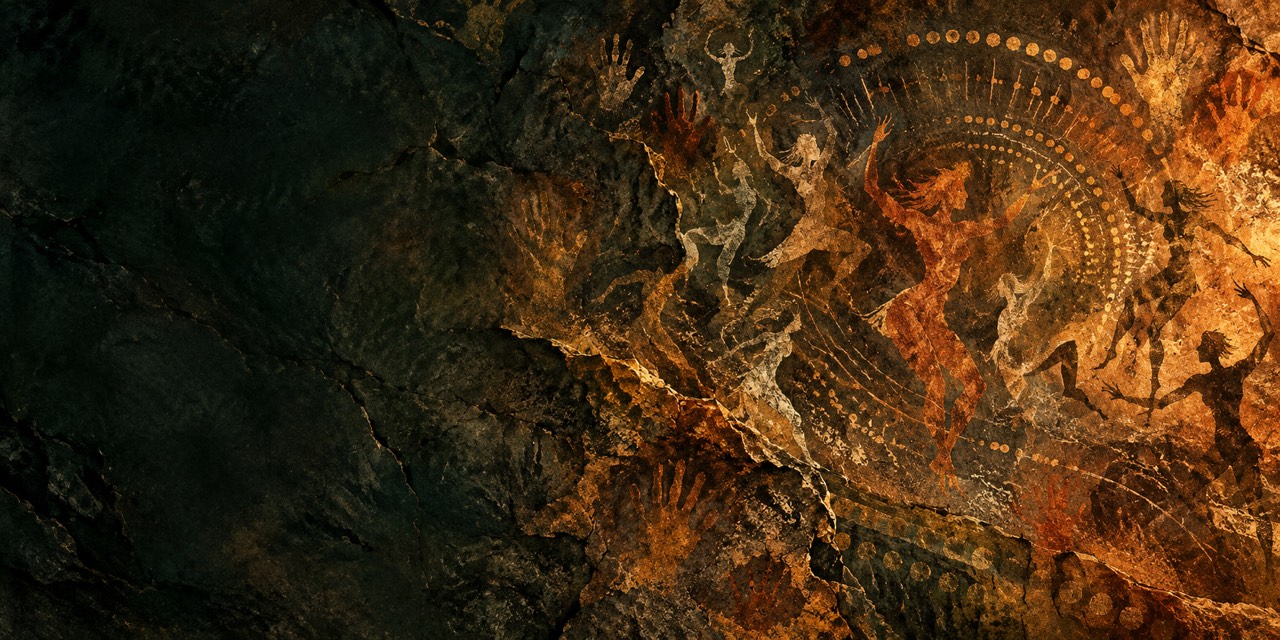
Before the record.
Then traces in stone.
Our lineage reaches back millions of years. No surviving trace dates its first Dance. Play and rhythm appear in lives beyond our species; they widen the question without supplying a prehistoric date. Begin there, then meet the images and objects that actually remain.
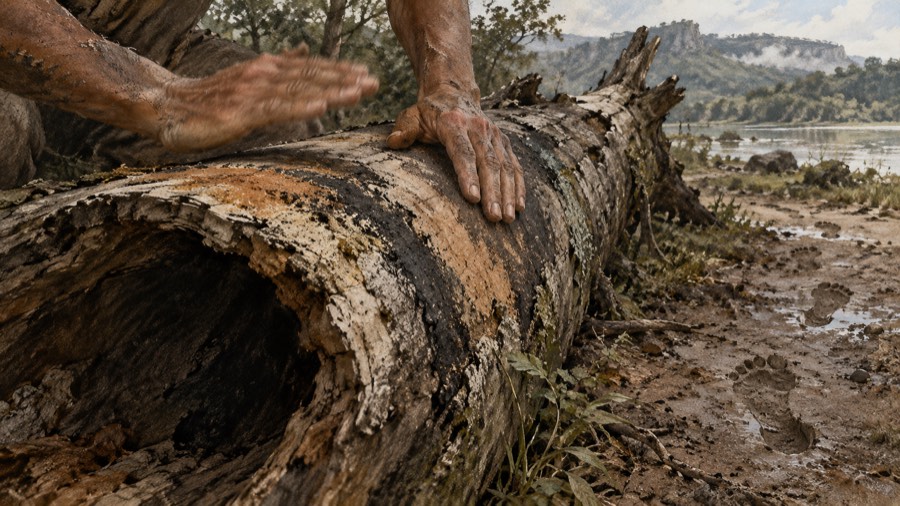 AI illustration · hypothetical wood percussionBefore the record · a million-year question
Who danced before the record?
Hominin lineage, Africa · no known Dance site
Open question · no direct traceOpen field note + sources ↗Living animals offer comparisons for rhythm and play, not a date or direct lineage for human Dance.The deep-time frame: hominin ancestors were walking upright millions of years ago; Homo sapiens appears about 300,000 years ago. Neither date is evidence of Dance. They tell us how wide the question may be, not where to place an event.
The body's beat: a heartbeat can be felt from within1. Feet, hands, and resonant wood could make sound without leaving a crafted instrument; they are possibilities, not a dated first drum. Could groups before our species have found movement and play together? We can ask without assigning them a human ceremony.
Living comparisons: wild chimpanzees drum patterned rhythms on tree buttresses2; chimpanzees in controlled experiments sway when sound plays3. Observers have documented social play from chimpanzee infancy through juvenility4. In male laboratory rats, restricted juvenile play changed later prefrontal connections and cognitive strategy5. Bumblebees rolling wooden balls met operational criteria for object play6. These studies concern different species and behaviors; none documents an ancestral Dance.
What survives: well-dated flutes from Germany’s Swabian Jura are about 42,000–43,000 years old7. They attest crafted instruments, not the first music. Skin, wood, and bodily percussion rarely leave comparable traces. We cannot rank vanished instruments, claim drums came first, or establish log drumming or Dance before control of fire from this record.
Significance: In these living studies, play is entwined with social relationships in chimpanzees and developing cognition in rats. That deepens the question of group movement before our species, while the archaeological silence keeps us from naming a first Dance or drawing a direct line to present floors.
Smithsonian: millions of years of bipedal history ↗ · Smithsonian: our species ↗ · Tübingen: dated flutes ↗ · Why early sound vanishes ↗Image: AI-generated speculative illustration of hands and a hollow log. No archaeological site, culture, or event is depicted.
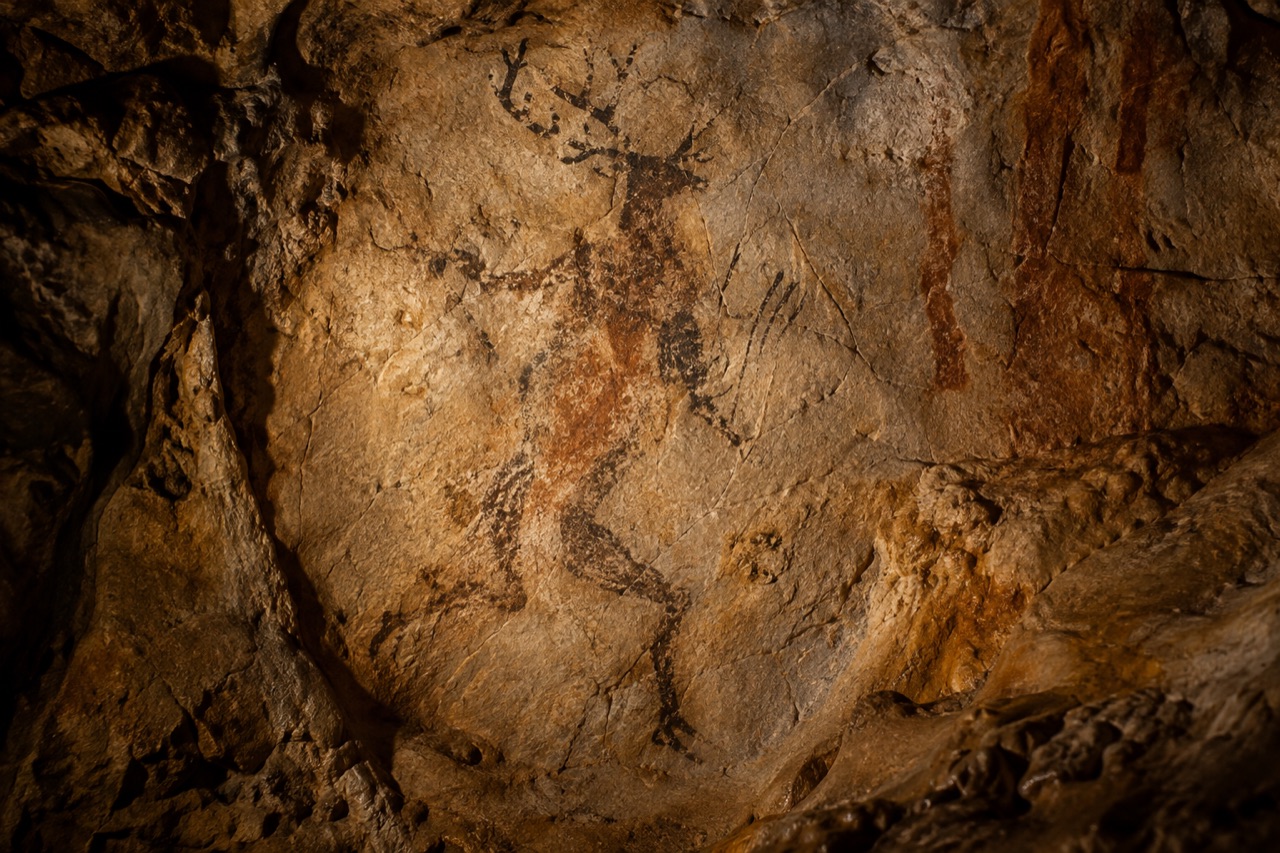 AI interpretation · cave wallc. 17,000 years ago · cave visitation, not image date
Les Trois-Frères: the “Sorcerer”
Ariège, France · Magdalenian cave art
Interpreted imageOpen field note + source ↗The figure exists; “dancing shaman” is a contested reading.Evidence: painted and engraved cave figure; radiocarbon dates support Magdalenian use of the cave, not a precise date for this image.
Limit: posture, identity, and trance are interpretations. Early tracings may have shaped the famous “Sorcerer” reading. It cannot anchor a continuous Dance lineage.
Significance: This figure became a potent image in later accounts of prehistoric trance. Re-examining its contested reading shows how one interpretation can shape modern imagination without proving an ancient Dance lineage.
CNRS rock-art archive ↗ · Interpretation critique ↗Image: AI-generated interpretive scene of a cave wall inspired by Les Trois-Frères; it is not an archival photograph and depicts no verified event or person.
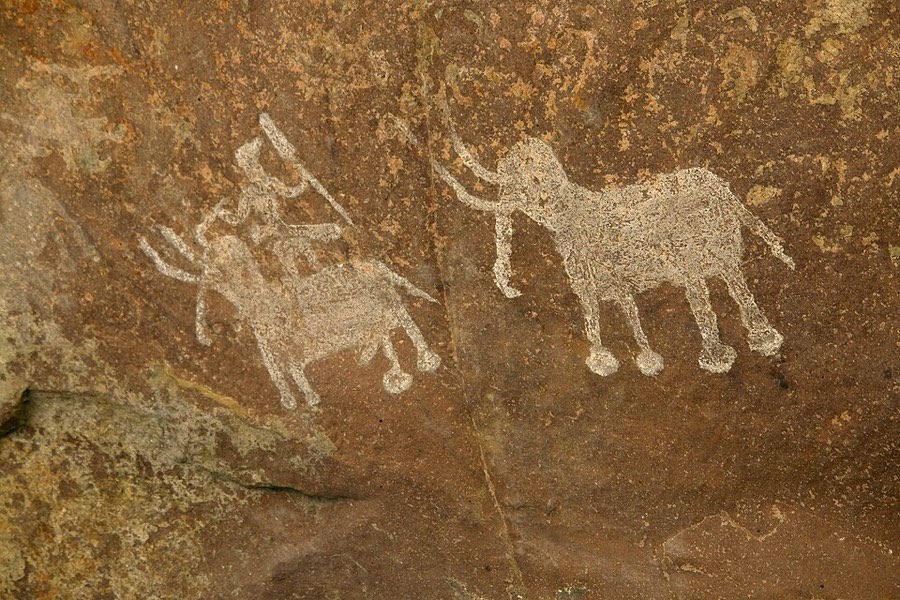 Site photograph · different motifMesolithic → historical periods
Bhimbetka’s painted shelters
Madhya Pradesh, India · multiple communities and periods
Rock art · mixed datesOpen field note + source ↗A site spanning millennia; no single date belongs to all its figures.Evidence: paintings across five shelter clusters, dated broadly from Mesolithic to historic times. A study held by India’s Indira Gandhi National Centre for the Arts identifies a masked dancer in one shelter.
Limit: dating any individual “Dance” motif is difficult; neither trance nor a link to later Indian Dance can be read from the paintings alone.
Significance: Bhimbetka places possible danced movement inside a long, layered South Asian rock-art record. The uncertain dates of individual motifs keep us from projecting later Indian traditions backward onto a painted shelter.
UNESCO site dossier ↗ · Rock-art study ↗Image: Yann Forget, “Rock painting, Bhimbetka,” 2012. Source ↗ · CC BY-SA 4.0 ↗. Embedded resize and display crop.
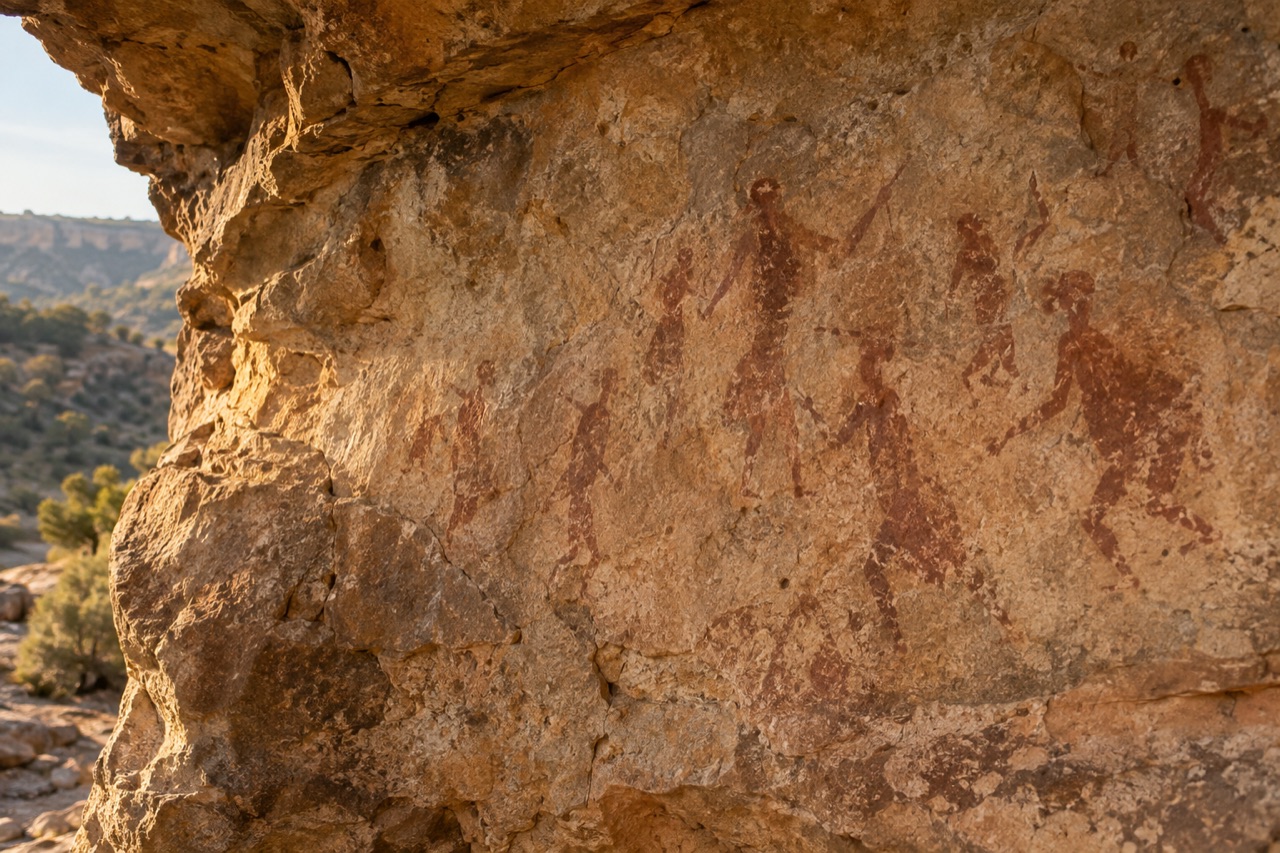 AI interpretation · rock shelterLate prehistory · broad range
Movement in Iberian rock art
Mediterranean Spain · many local sites
Rock art · interpretationOpen field note + source ↗Motion in an image is visible; its ritual and emotional meaning is harder to recover.Evidence: UNESCO describes late prehistoric scenes of collective life and ritual across hundreds of sites.
Limit: the corpus is not one event or one culture. Calling every active pose a Dance would exceed what the art establishes.
Significance: The Iberian corpus widens the archive beyond one famous cave. Its varied scenes invite comparison of movement in late prehistoric art while keeping each site and gesture open to interpretation.
UNESCO rock-art overview ↗Image: AI-generated interpretive scene of a prehistoric Iberian rock shelter; it is not an archival photograph and depicts no verified event or person.
Evidence behind the openingResearch notes9 brief sources · open to read
These studies illuminate possibilities. None dates a first Dance or instrument.
- Feeling the pulse. Pollatos et al. (2005) ↗ — Heartbeat perception is measurable; “inner drum” remains a metaphor.
- Chimpanzee tree drumming. Eleuteri et al. (2025) ↗ — Wild chimpanzees drum with patterned timing; this does not date human Dance.
- Sound and swaying. Hattori & Tomonaga (2020) ↗ — Captive chimpanzees swayed to sound; ceremony was not studied.
- Social play. Cordoni & Palagi (2011) ↗ — Chimpanzee play changes with age and social context.
- Play and development. Bijlsma et al. (2022) ↗ — A rat study linked restricted peer play with later neural and task differences.
- Play beyond mammals. Galpayage Dona et al. (2022) ↗ — Bumblebee ball rolling met criteria for object play, not Dance.
- Surviving instruments. Conard et al. (2009) ↗ — Ancient flutes survive; they do not identify the first instrument.
- Moving together. Tarr et al. (2016) ↗ — One experiment found greater reported closeness after synchronized group Dance.
- Spontaneity and form. Hannay, McLeish & Schofield (2024) ↗ — A cultural-evolution account distinguishes spontaneous Dance from socially transmitted forms; it does not reconstruct the first Dance.
What did the ground hear that stone never learned to keep?
Historical records
and living traditions.
Artifacts and texts identify particular peoples and practices. A record of a Dance is evidence of that moment, not its beginning.
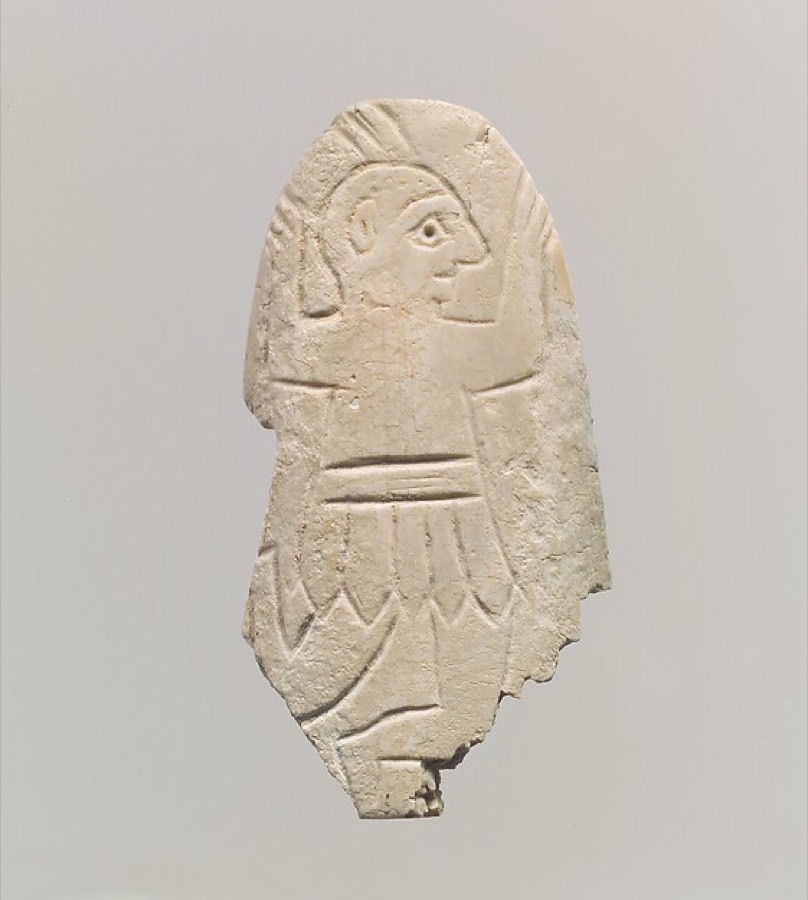 Object photograph · The Metc. 2600–2350 BCE
A dancer in Sumerian inlay
Nippur, Mesopotamia · Sumerian
Excavated objectOpen field note + source ↗An unusually concrete early depiction of a dancer.Evidence: excavated object catalogued by The Met as a dancing man.
Limit: the museum suggests ritual purification from the figure’s shaved head and beard; the image does not show trance or a recoverable choreography.
Significance: The excavated inlay is rare material evidence of a dancer in an early Mesopotamian setting. It establishes an ancient representation of Dance, not a transmission route to present practices.
The Met object record ↗Image: The Metropolitan Museum of Art, Sumerian shell inlay from Nippur. Open Access / Public Domain source ↗. Embedded resize.
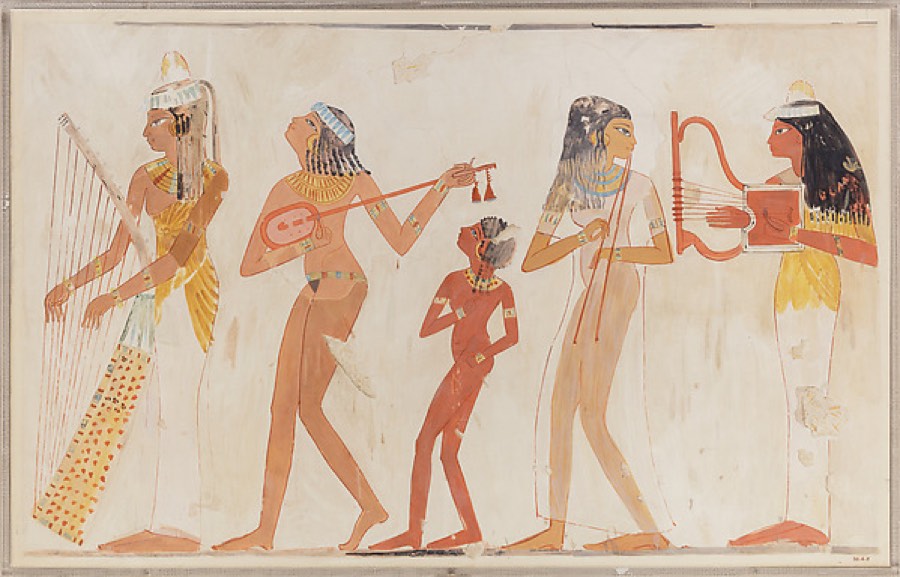 Original scene · later facsimilec. 1396–1386 BCE · original painting
Music and Dance at an Egyptian feast
Thebes, Egypt · New Kingdom, Dynasty 18
Painted tomb sceneOpen field note + source ↗Dancing is explicit; “ecstatic” would be a modern projection.Evidence: tomb of Djeserkareseneb, documented through a Met facsimile; the museum associates the larger banquet with the Beautiful Festival of the Valley.
Limit: an image of celebration tells us little about each participant’s inner experience.
Significance: The paired dancer and musicians make Dance visible in a New Kingdom ceremonial and social setting. Their image preserves a relationship between movement and music without disclosing the performers’ inner states.
The Met: Music and Dance ↗Image: The Metropolitan Museum of Art, facsimile of the Djeserkareseneb tomb painting. Open Access / Public Domain source ↗. Embedded resize.
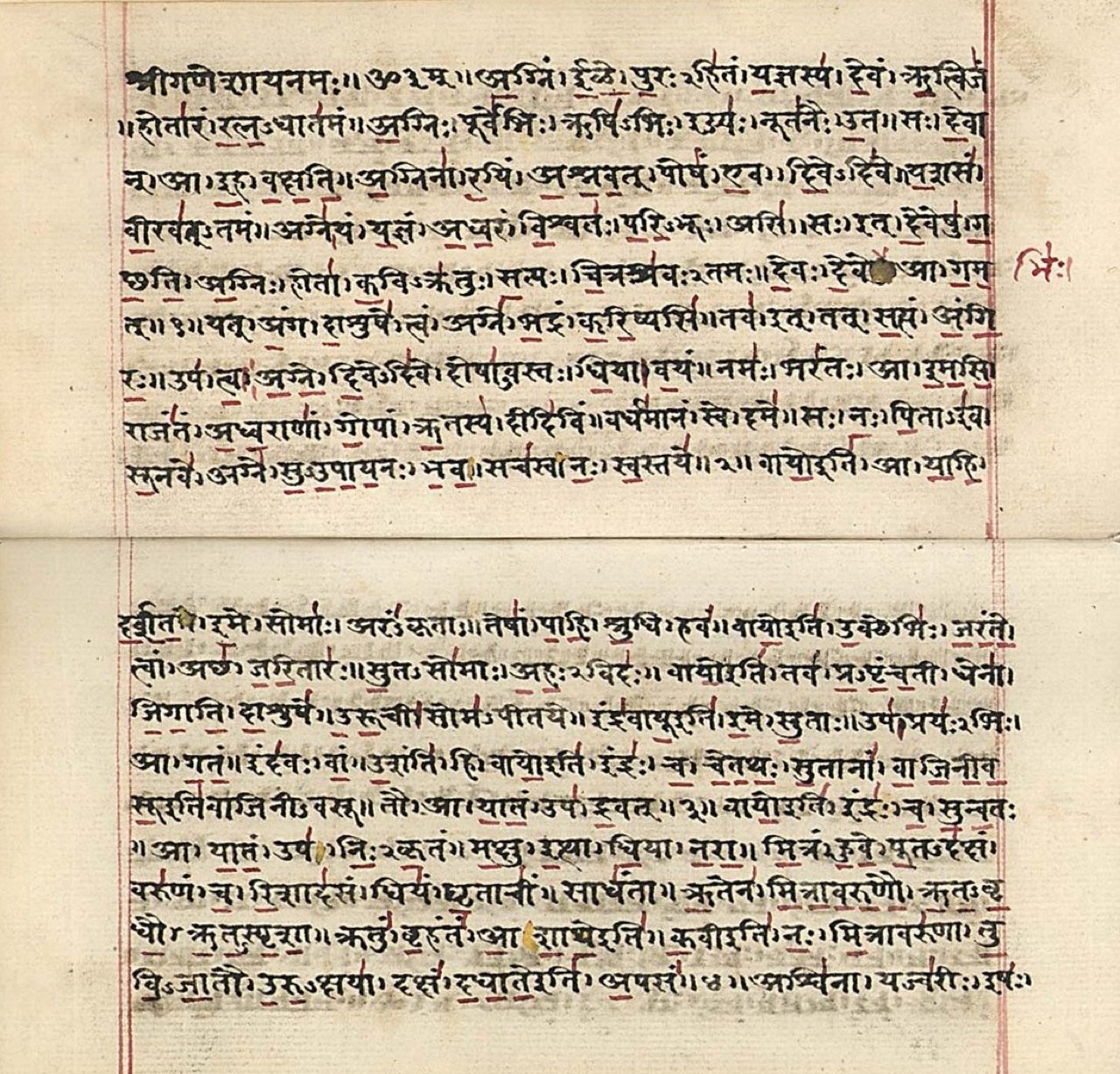 Later manuscript · RigvedaLate 2nd–early 1st millennium BCE · broad textual horizon
Vedic words for movement
Indian subcontinent · Sanskrit textual traditions
Textual evidenceOpen field note + source ↗Vedic references are not a script for today’s ecstatic Dance.Evidence: the Ṛgveda compares Uṣas to a dancer; other Vedic texts name Dance and song. The long oral and textual chronology resists a single date.
Limit: these passages attest concepts of dancing; they do not establish free-form trance practice or direct descent from Bhimbetka.
Significance: These passages place Dance in an early South Asian textual world alongside music and sacred language. They broaden the record beyond images, although no choreography or modern lineage follows from the words alone.
Study of performance in Vedic texts ↗Image: Later manuscript; it is not a Vedic-era object. Rigveda manuscript ↗ · Public domain. This is a later or contextual image, not a photograph of the historical moment described.
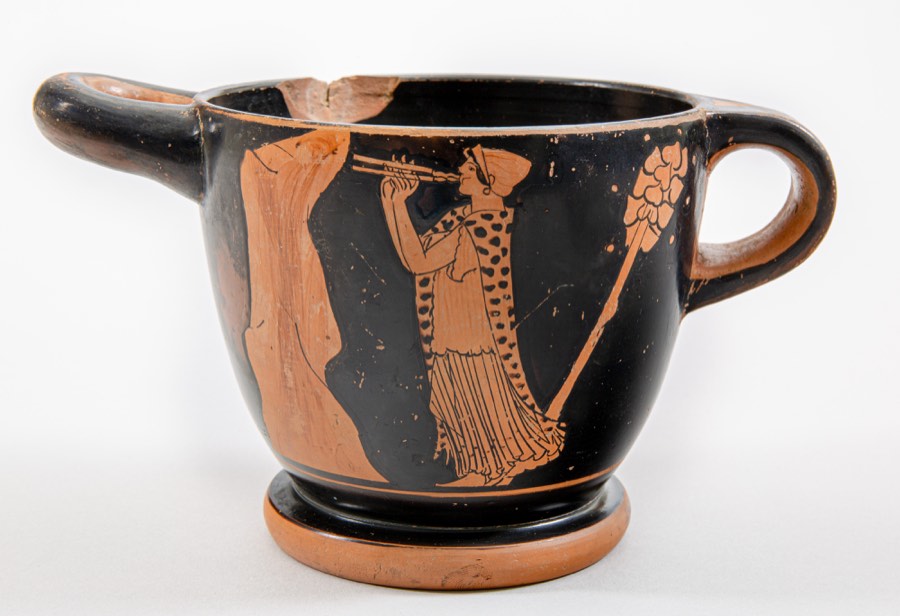 Object photograph · The Metc. 490–480 BCE
Dionysian motion on a Greek cup
Attica, Greece · followers of Dionysos
Painted vesselOpen field note + source ↗A Greek ritual world, not a template for modern free Dance.Evidence: an Attic cup attributed to the Brygos Painter depicts two maenads, followers of Dionysos.
Limit: images and literary descriptions of Dionysian rites do not give us a single uniform practice, nor a documented line to contemporary Ecstatic Dance.
Significance: The maenads make Dionysian movement visible in Greek material culture. The cup gives later viewers a window into that specific religious world, not a template for a present-day free-Dance floor.
The Met vessel record ↗Image: The Metropolitan Museum of Art, Attic cup attributed to the Brygos Painter. Open Access / Public Domain source ↗. Embedded resize.
 AI interpretation · performance textc. 2nd century BCE–4th century CE · debated
The Nāṭyaśāstra
Indian subcontinent · Sanskrit performing arts
Historical textOpen field note + source ↗A rich theory of performance; its composition date is disputed.Evidence: the text is attributed to Bharata Muni and transmitted through later manuscripts; scholars debate its formation over centuries.
Limit: it is not evidence that Indian performance descended from a particular prehistoric image, nor that all Indian Dance was ecstatic trance.
Significance: The treatise preserves a major intellectual framework for Indian performing arts. It shows a historically influential path of formalized Dance that should be understood on its own terms, apart from modern open formats.
UNESCO manuscript record ↗ · Dating discussion ↗Image: AI-generated interpretive scene of a manuscript and hand gesture; the pictured writing is invented and is not a manuscript facsimile; it is not an archival photograph and depicts no verified event or person.
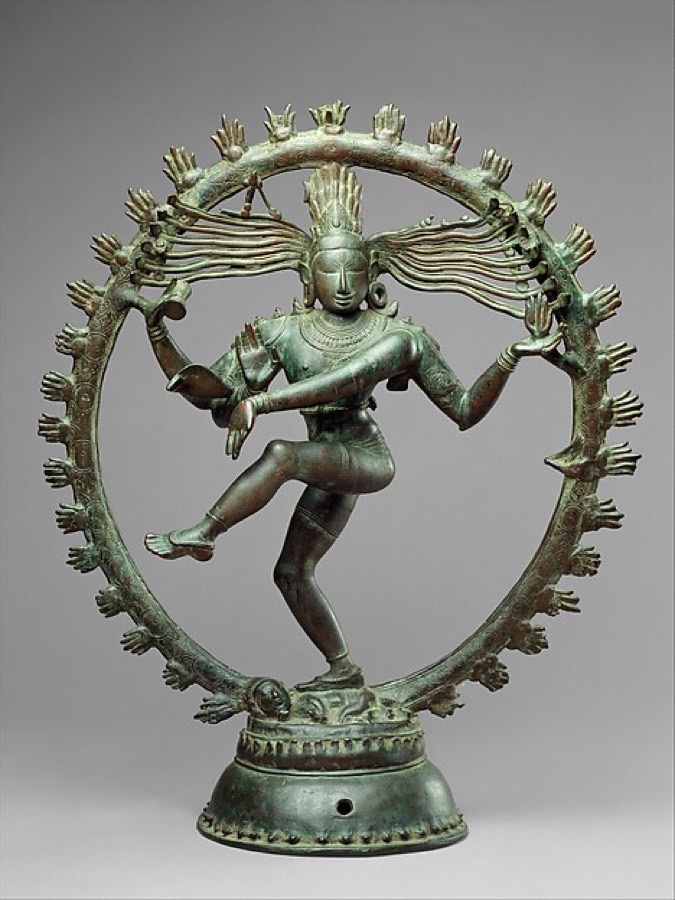 Chola bronze · The Met5th century imagery → 11th century icon
Śiva as Naṭarāja
Tamil Nadu, India · Hindu devotional art
Art history / sacred iconOpen field note + source ↗The celebrated Chola form is medieval, not a Vedic-period artifact.Evidence: The Met dates its Chola bronze to the late 11th century and notes sculptural Naṭarāja imagery by the fifth century.
Limit: a sacred image has its own theology and art history; it is not a claim that modern free-form Dance copies an ancient practice.
Significance: Naṭarāja made cosmic Dance a lasting visual and theological image in Śaiva devotion. Its reach as a symbol can invite reflection today, while its specific religious meaning remains its own.
The Met: Śiva as Lord of Dance ↗Image: The Metropolitan Museum of Art, Chola bronze of Śiva as Naṭarāja. Open Access / Public Domain source ↗. Embedded resize.
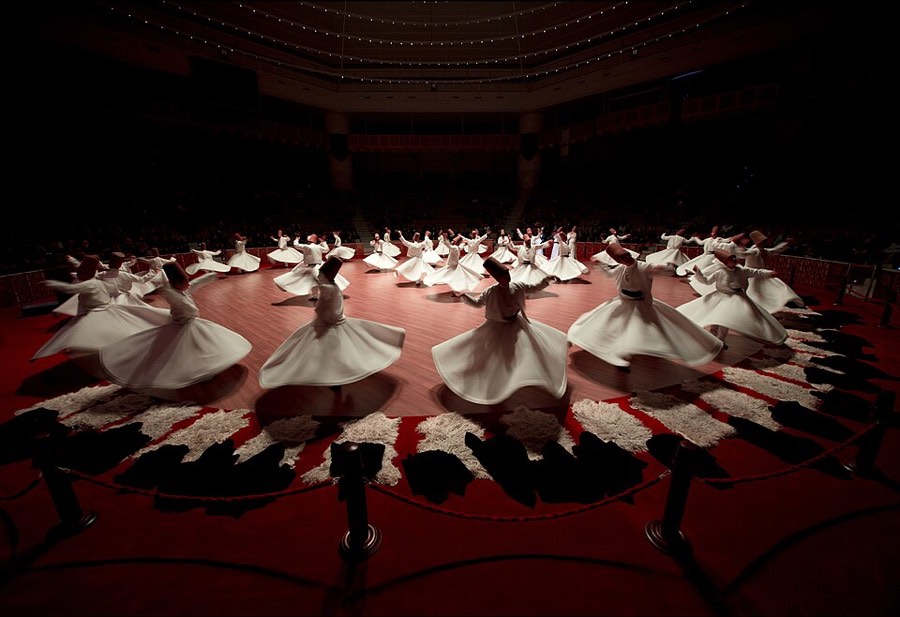 Contemporary ceremony photographOrder formed after 1273 · practiced today
Mevlevi sema
Konya, Türkiye · Mevlevi Sufi order
Living religious traditionOpen field note + source ↗Specific devotional practice; the word “whirling” alone misses its context.Evidence: UNESCO traces the Mevlevi order to the period after Rumi’s death in 1273 and documents sema’s music, training, and transmission.
Limit: sema is neither generic “trance Dance” nor an ancestor of the contemporary Ecstatic Dance event format. Contexts of public performance have also changed over time.
Significance: Sema keeps turning, music, training, and prayer together in a living devotional ceremony. Its continuity expands the story beyond entertainment while offering no claimed ancestry for the modern named format.
UNESCO sema description ↗Image: Tahirceylan, “Sema Ceremony,” 2016. Source ↗ · CC BY-SA 4.0 ↗. Embedded resize and display crop.
Modern
Offerings.
Modern free-Dance and somatic approaches took shape alongside much older living traditions documented in the same century. For those living traditions, the dates mark a recording or institution—not an origin.
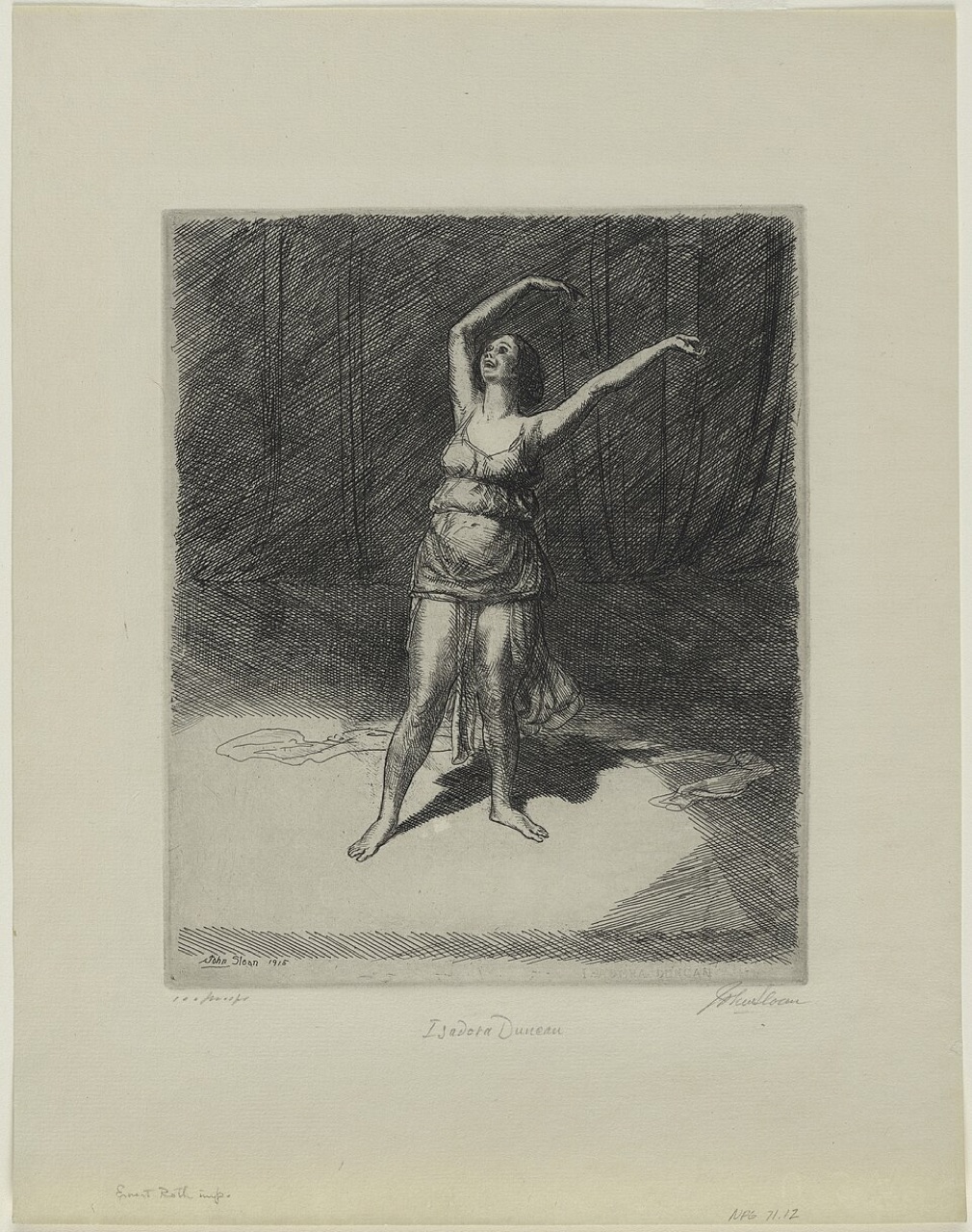 Archival portrait · 1915Around 1900
Isadora Duncan breaks the frame
United States & Europe · modern Dance
Modern Dance historyOpen field note + source ↗A documented artistic precursor to later ideals of bodily freedom.Evidence: the Isadora Duncan Dance Foundation traces her free-flowing style and turn away from ballet technique.
Relationship: an important modern Dance precedent, not a demonstrated direct founder of the named Ecstatic Dance movement.
Significance: Duncan widened the possibilities of Western stage Dance with barefoot, expressive movement. She is an important modern precedent for bodily freedom, though no direct organizational line to Ecstatic Dance is established here.
Isadora Duncan Dance Foundation ↗Image: Isadora Duncan, 1915 ↗ · public domain archival portrait. It does not show a performance.
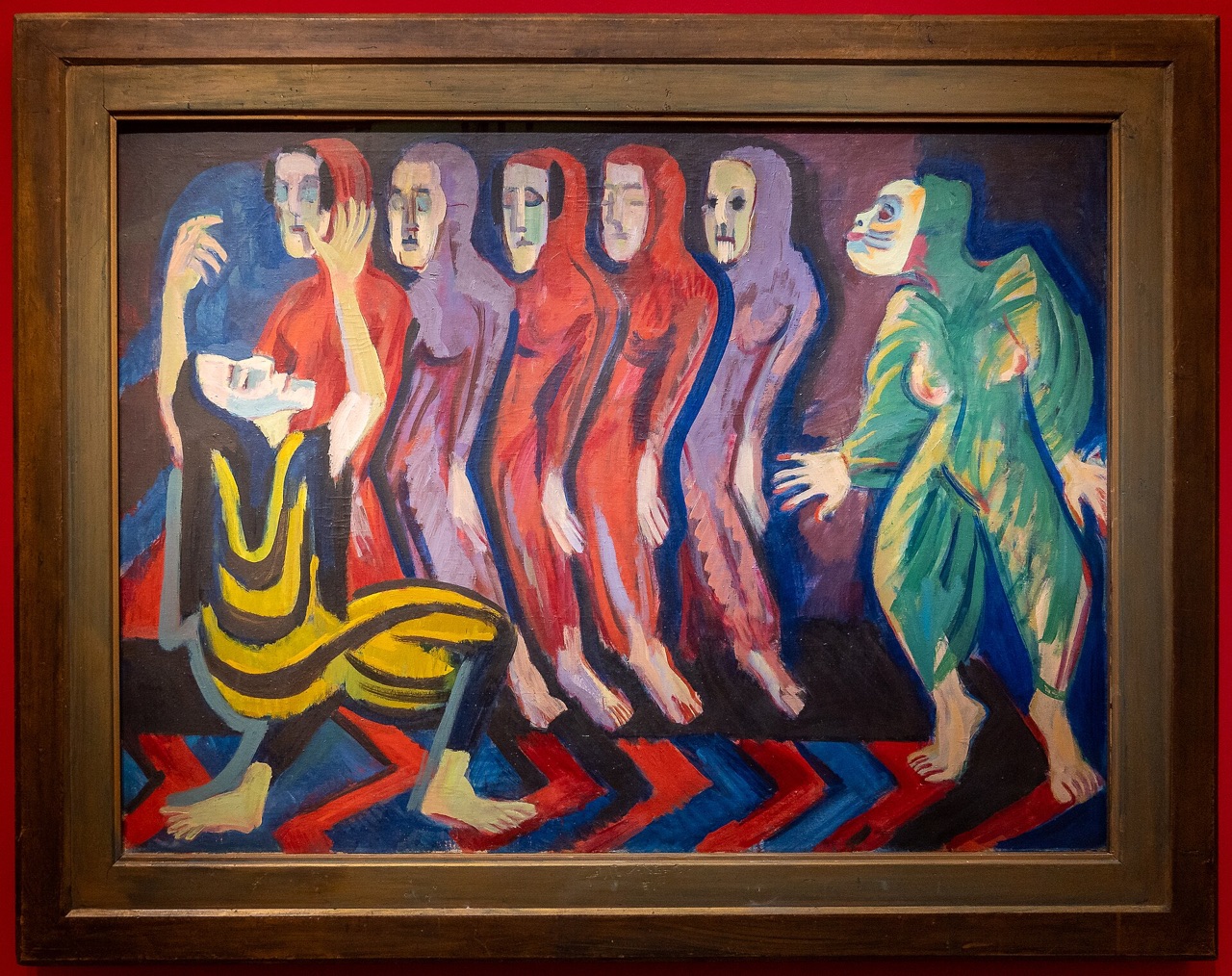 Historical artwork · Mary Wigman1910s–1920s
Ausdruckstanz / expressionist Dance
Germany & Switzerland · Mary Wigman, Rudolf von Laban
Modern Dance historyOpen field note + source ↗A distinct artistic movement with its own social history.Evidence: archival accounts place Wigman with Laban at Monte Verità and her Dresden school opening in 1920.
Relationship: a broad free-Dance precedent. Similar movement values do not by themselves prove a direct route to present-day conscious Dance.
Significance: Wigman and her contemporaries enlarged the vocabulary of European modern Dance through expressive movement. Their work made room for new forms of bodily inquiry without proving a direct route to present-day conscious Dance.
Leipzig Dance Archive ↗Image: Ernst Ludwig Kirchner’s Totentanz der Mary Wigman ↗ · public domain artwork, an artist’s interpretation rather than a performance photograph.
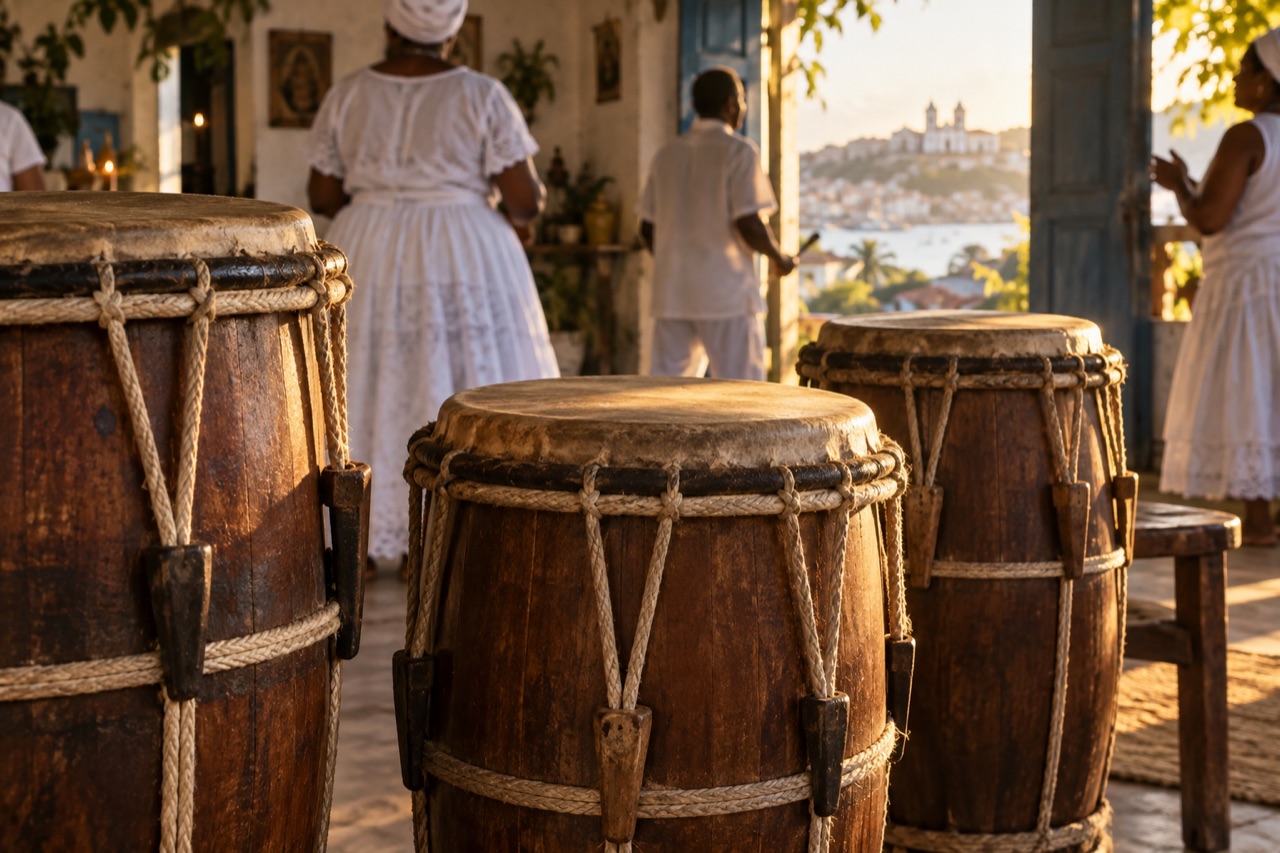 AI interpretation · Bahia drums1941–42 field recordings · ongoing practice
Candomblé Dance and orixás
Salvador, Bahia, Brazil · Afro-Brazilian religious houses
Living tradition / field recordOpen field note + source ↗The 1940s date is documentation, not an origin date.Evidence: Smithsonian liner notes describe Melville Herskovits’s Bahia recordings and named orixá rhythms.
Relationship: African diasporic continuity has its own historically traceable paths. It should not be collapsed into “African trance” or treated as a source of unlicensed modern choreography.
Significance: The recordings preserve named orixá rhythms in an archive while living religious houses sustain the ceremony. This is African diasporic continuity with its own history, not a generic source for modern Dance floors.
Smithsonian Folkways notes ↗Image: AI-generated interpretive scene of atabaque drums in a Bahia community setting; it is not a photograph of a Candomblé rite; it is not an archival photograph and depicts no verified event or person.
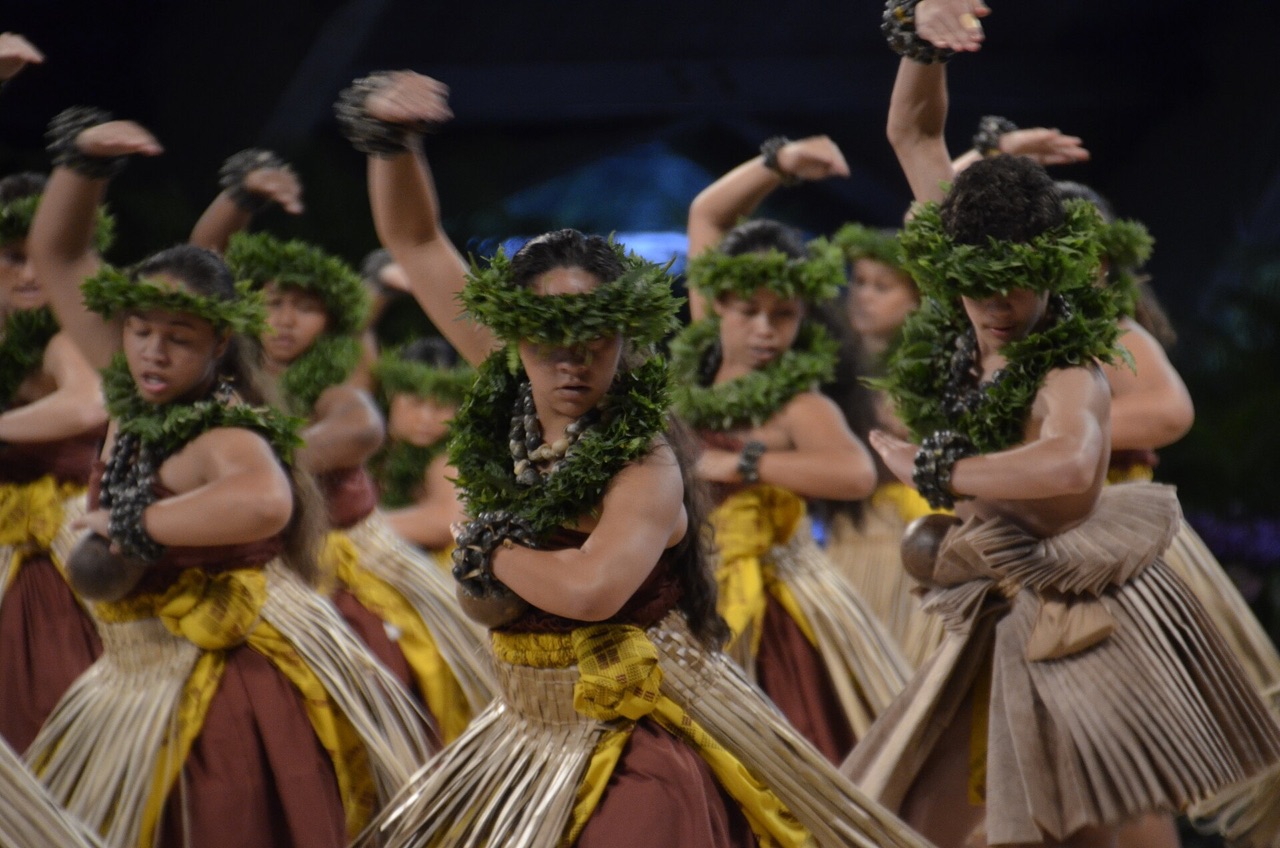 Documented performance · hula1953 hālau founding · older practice
Hula as Hawaiian knowledge
Hawaiʻi · Edith Kanakaʻole & Hālau o Kekuhi
Living Indigenous traditionOpen field note + source ↗Hula is not simply “ecstatic Dance.”Evidence: the Smithsonian documents Kanakaʻole’s hālau founding in 1953 and the inseparability of chant and Dance in her practice.
Limit: the date marks one school, not hula’s origin. Hawaiʻi’s role in the modern named Ecstatic Dance format is a separate 2000s story; that story does not make hula its ancestor.
Significance: Kanakaʻole’s hālau makes hula’s teaching of place, genealogy, chant, and embodied Hawaiian knowledge visible. It also corrects a false shortcut: the Hawaiʻi setting of modern Ecstatic Dance does not make hula its precursor.
Smithsonian on Edith Kanakaʻole ↗Image: Thomas Tunsch, hula performance ↗ · CC BY-SA 4.0 ↗; resized/display crop. This later performance does not depict Edith Kanakaʻole or the founding of Hālau o Kekuhi.
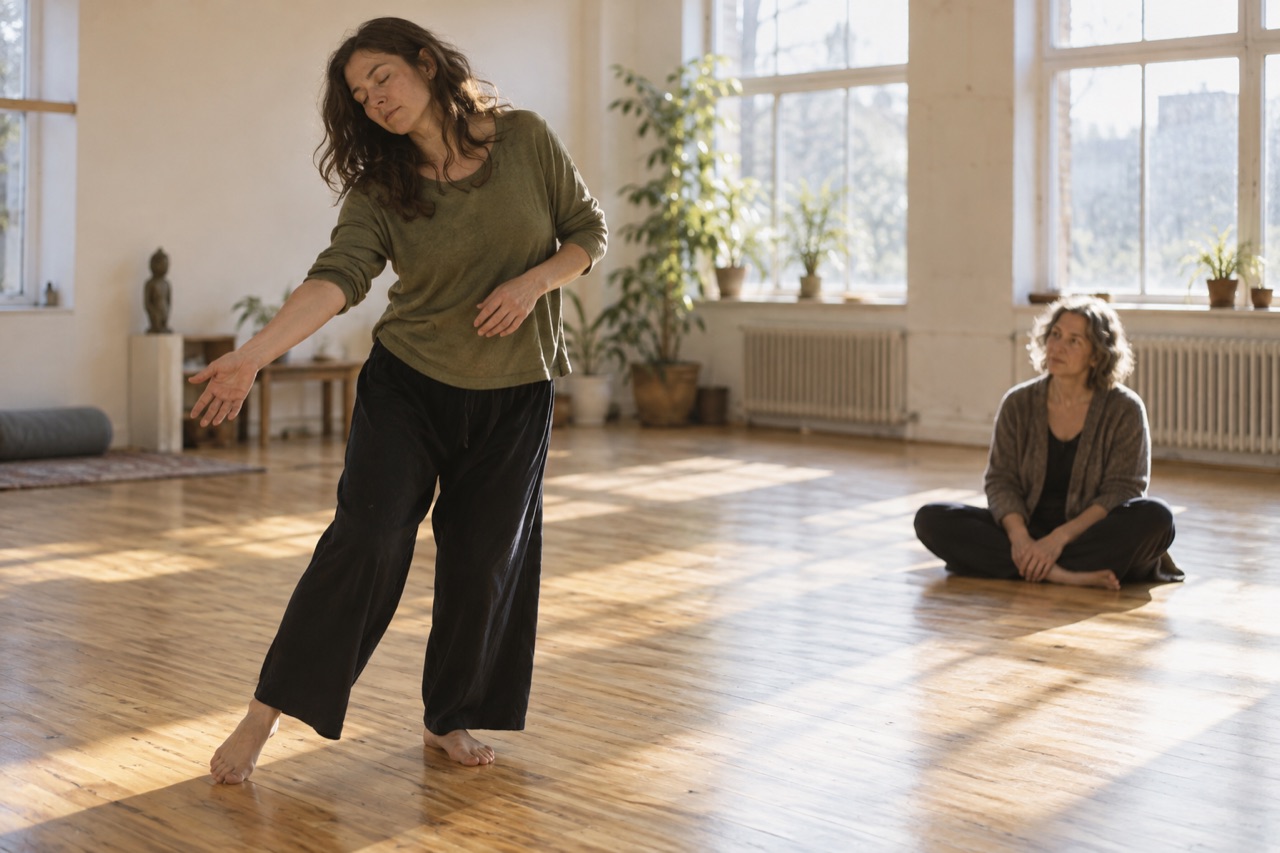 AI interpretation · mover and witness1950s movement-in-depth → later Authentic Movement
Authentic Movement
United States · Mary Starks Whitehouse
Somatic practice historyOpen field note + source ↗Its mover–witness structure is more specific than “Dance freely.”Evidence: Whitehouse’s mid-century movement-in-depth work and later writing by Janet Adler and Joan Chodorow document a practice with Jungian and Dance-therapy roots. The name Authentic Movement came later.
Relationship: a neighboring modern somatic stream; no single line from it to the branded Ecstatic Dance format is asserted here.
Significance: Authentic Movement offered a structured way to attend to inner sensation and witnessing. It belongs to the wider modern somatic landscape, without a claimed founding line to the DJ-led Ecstatic Dance format.
Whitehouse, Adler & Chodorow essays ↗Image: AI-generated interpretive scene of a mover-and-witness session; no specific workshop or teacher is shown; it is not an archival photograph and depicts no verified event or person.
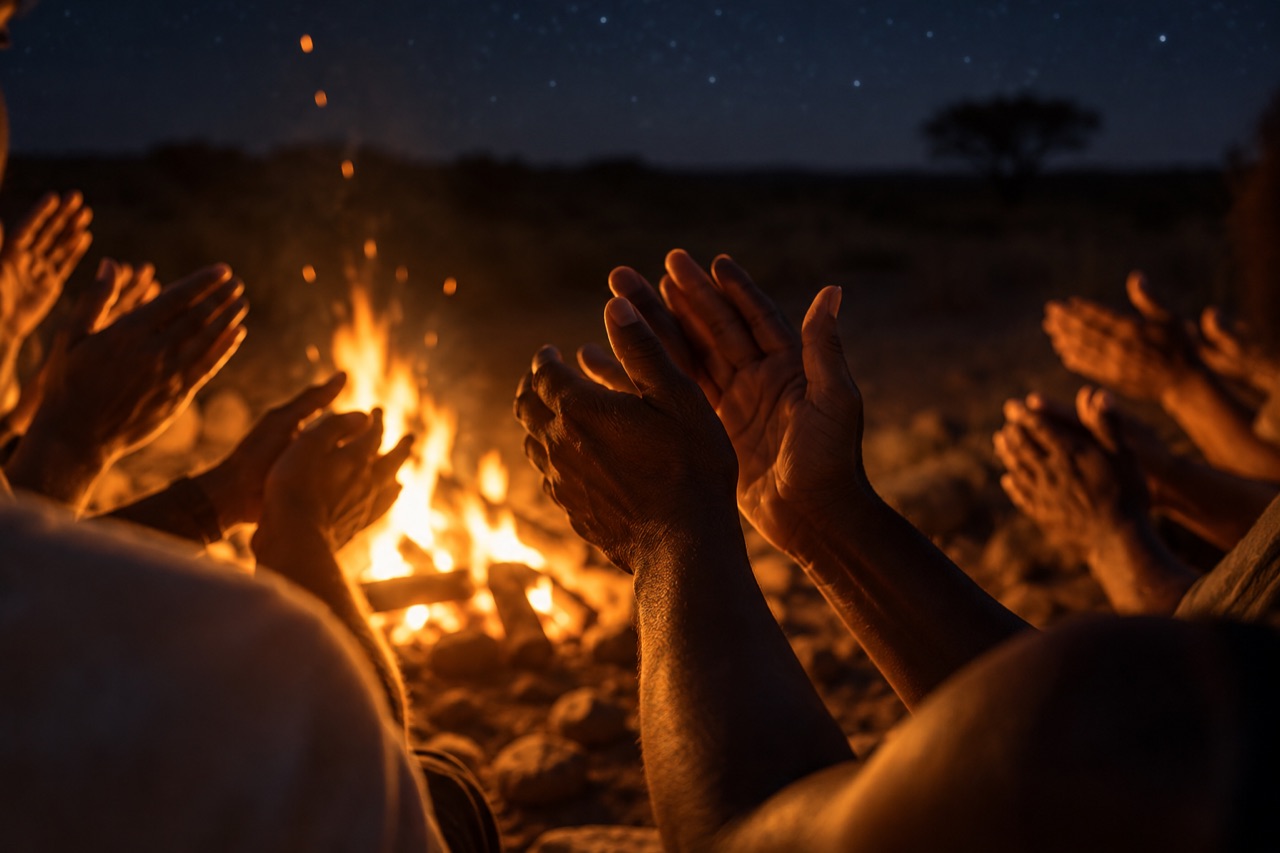 AI interpretation · rhythm and fire1957–58 film · ongoing tradition
Ju/’hoansi healing Dance
Northwestern Kalahari · Ju/’hoansi communities
Ethnographic filmOpen field note + source ↗Direct film evidence is modern; antiquity of an unchanged form is not proved.Evidence: John Marshall shot footage of a n/um tchai ceremony in 1957–58; the film was released later, and Smithsonian recordings document related music.
Limit: this is a living, changing community practice. Southern African rock art may be interpreted with ethnography, but the film does not prove today’s ceremony existed unchanged for tens of thousands of years.
Significance: The film and recordings document a specific living healing practice and inform careful discussion of San rock art. They also show why a twentieth-century record cannot prove an unchanged prehistoric ceremony.
Smithsonian film archive ↗Image: AI-generated interpretive scene of hands clapping near a fire; it does not document a Ju/’hoansi community or healing ceremony; it is not an archival photograph and depicts no verified event or person.
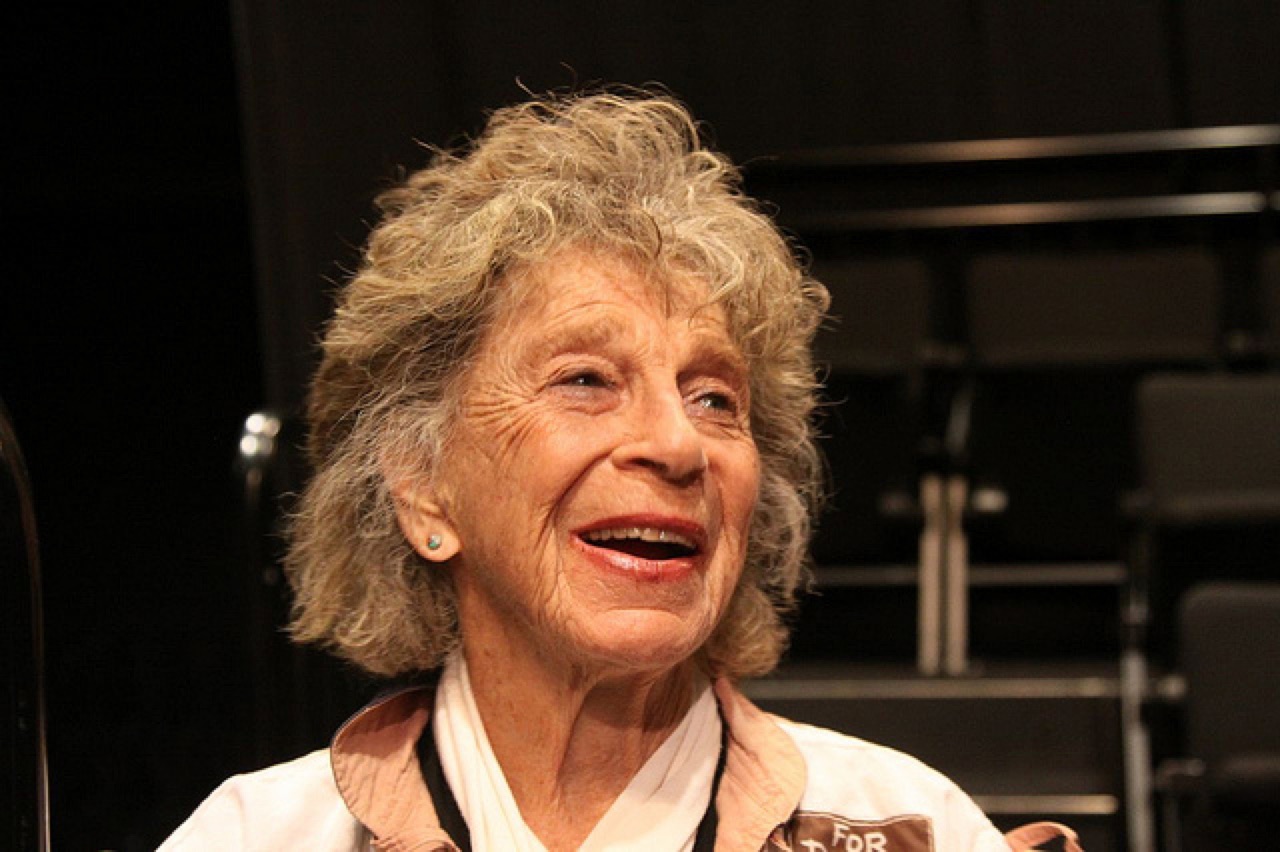 Photograph · Anna Halprin1960 workshop
Anna Halprin’s movement laboratory
Mt. Tamalpais, California · Halprin, Simone Forti, Yvonne Rainer
Archival Dance historyOpen field note + source ↗A documented modern experimental strand.Evidence: the New York Public Library documents Halprin’s August 1960 workshop and its artistic network.
Relationship: helped reshape postmodern Dance and participatory movement culture; direct influence on every later free-Dance event is not claimed.
Significance: Halprin’s workshops helped move Western concert Dance toward scores, everyday actions, and participatory experiment. That expansion shaped postmodern movement culture, without making her the inventor of every later open floor.
NYPL: Radical Bodies ↗Image: Shawn Calhoun, Anna Halprin (2010) ↗ · CC BY-SA 3.0 ↗; resized/display crop. This portrait is later than the events described.
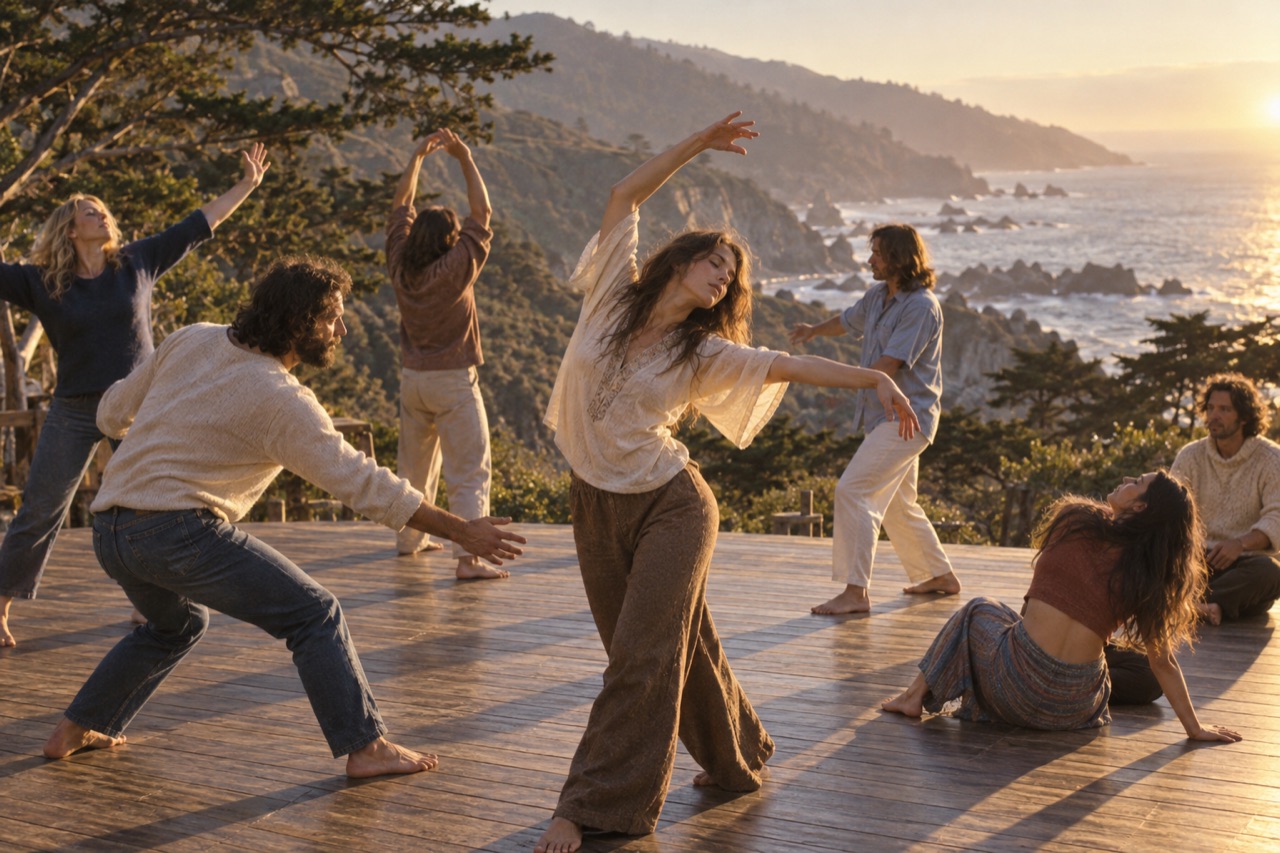 AI interpretation · Big Sur workshop1962 founding → mid-1960s movement work
Esalen as a meeting ground
Big Sur, California · human potential movement
Institutional historyOpen field note + source ↗One influential modern setting, not the origin of dancing for healing.Evidence: Esalen dates its founding to 1962 and Gabrielle Roth’s arrival to the mid-1960s.
Relationship: a documented incubator for Roth’s later 5Rhythms work, alongside many other practices. Esalen itself did not invent ecstatic movement.
Significance: Esalen provided a documented meeting ground for artists and teachers, including Roth. It helps explain one modern route into conscious Dance while remaining only one place in a much wider history.
Esalen history ↗ · On Gabrielle Roth ↗Image: AI-generated interpretive scene of a period-plausible outdoor movement workshop near Big Sur; it is not an Esalen archival photograph; it is not an archival photograph and depicts no verified event or person.
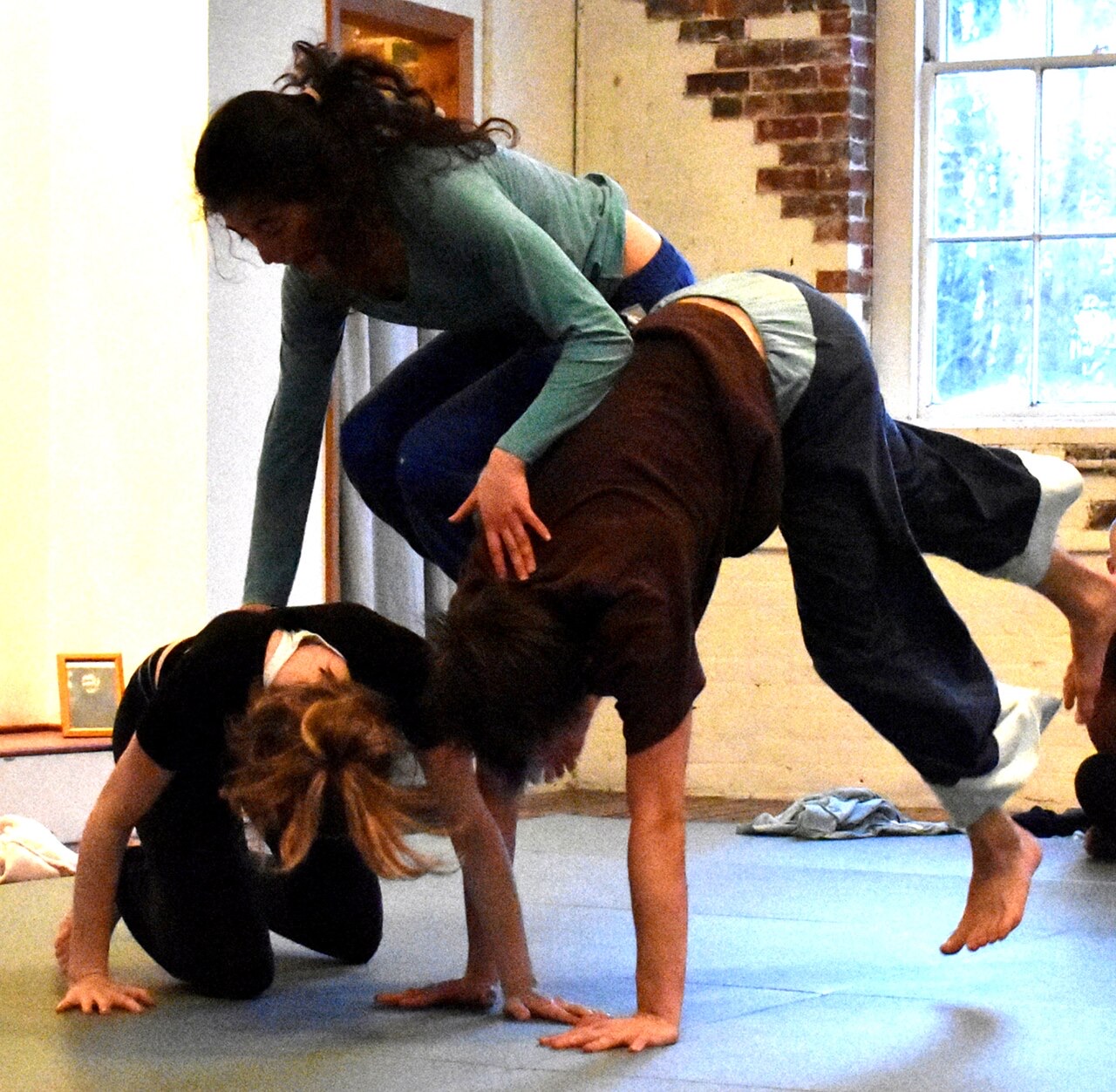 Documented practice · later workshop1972
Contact Improvisation
New York City · Steve Paxton & collaborators
Documented practiceOpen field note + source ↗A named improvisational form, not just unstructured dancing.Evidence: Contact Quarterly dates the first performances to June 1972 at John Weber Gallery.
Relationship: part of modern free-movement culture. Contemporary Ecstatic Dance organizers sometimes offer Contact Improvisation as a warm-up, a documented relationship rather than a claim of sole ancestry.
Significance: Contact Improvisation widened modern Dance’s exploration of shared weight, gravity, and responsive movement. Its use as a warm-up at some Ecstatic Dance gatherings is a specific documented connection, not sole ancestry.
Contact Quarterly history ↗Image: Koyaanisqatsi12, Contact Improvisation trio (2017) ↗ · CC BY-SA 4.0 ↗; resized/display crop. It shows later practice, not the 1972 beginnings.
Dance floors
today.
Late-century records bring different Dance worlds into view: Bronx street Dance cyphers, 5Rhythms, electronic rave floors, Yorùbá bàtá, and Ecstatic Dance. The bàtá recording documents an older living practice, not its beginning. The directory sample below follows one modern format, not every place people Dance together.
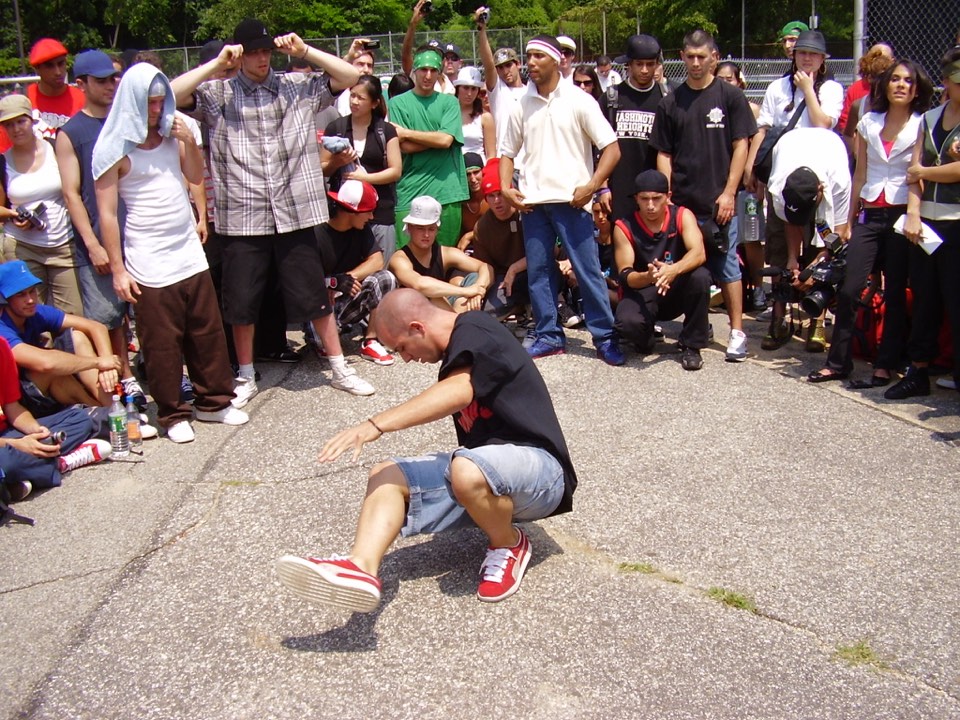 Documented cypher · Bronx, 20071971–75 roots · 1979–84 codification
Bronx street Dance and the cypher
West Bronx, New York City · Black and Latino Dance communities
Documented street Dance historyOpen field note + sources ↗Improvised movement with a learned vocabulary and social rules.Evidence: The Bronx County Historical Society documents West Bronx Burning (1971–75) as head-to-head freestyle Dance in a circle, then traces the expanding breaking repertoire and crews of 1979–84. The later photograph shows a Bronx cypher in 2007.
Relationship: Freestyle here has learned moves, battle conventions, and community history. Other street Dances, including locking, popping, and house, have distinct roots; this entry does not fold them into Bronx breaking or claim a direct line to the modern Ecstatic Dance format.
Significance: The cypher makes real-time invention a social exchange: dancers listen, respond, and bring their own voice into the circle. Bronx breaking grew into a precise, evolving art and reached global audiences, showing how improvisation can gain a rich vocabulary without becoming fixed choreography.
Bronx Historical Society: Burning ↗ · Bronx Historical Society: Breakin’ ↗ · Imani Kai Johnson on cyphers ↗Image: NexusMoves, B-boy Pumba at a Rock Steady Crew anniversary cypher in the Bronx (2007) ↗ · CC BY-SA 3.0 ↗; resized for display. This later event is contextual evidence, not a photograph of the 1970s origins.
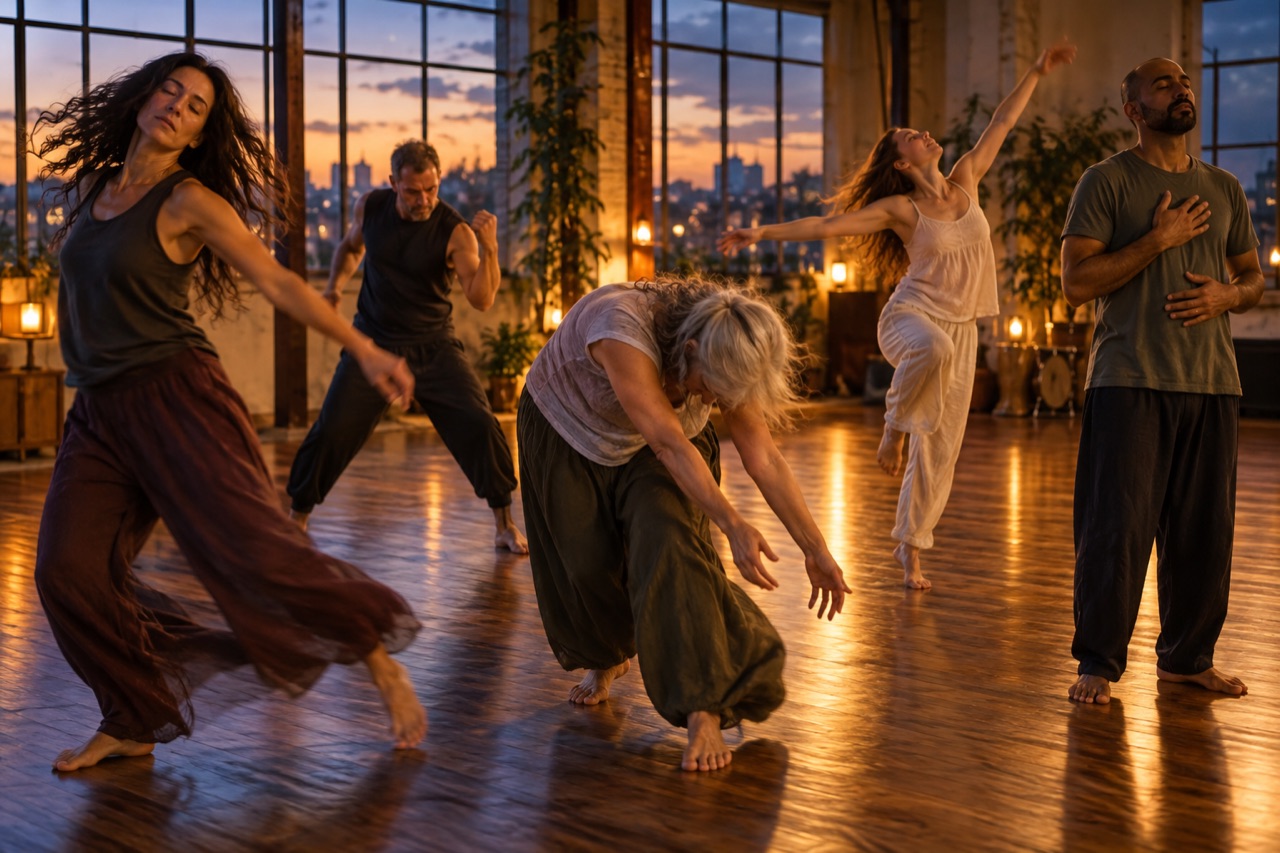 AI interpretation · 5Rhythms floor1977 center · 1988 teacher training
Gabrielle Roth’s 5Rhythms
Esalen → New York City · Roth & The Moving Center
Documented modern methodOpen field note + source ↗Older than the 2000s named Ecstatic Dance format, and distinct from it.Evidence: 5Rhythms records The Moving Center’s 1977 founding and teacher training from 1988; Esalen documents Roth’s earlier work there.
Relationship: a well-documented influence in conscious Dance circles, with its own named sequence and teaching structure. It is not interchangeable with an open DJ-led Ecstatic Dance floor.
Significance: Roth’s 5Rhythms offered an influential map for improvised movement. Kalani organizers explicitly name it as an influence on their musical wave, making this one traceable bridge to the contemporary format.
5Rhythms history ↗Image: AI-generated interpretive scene of a contemporary 5Rhythms-style group; it is not a Gabrielle Roth archive photograph; it is not an archival photograph and depicts no verified event or person.
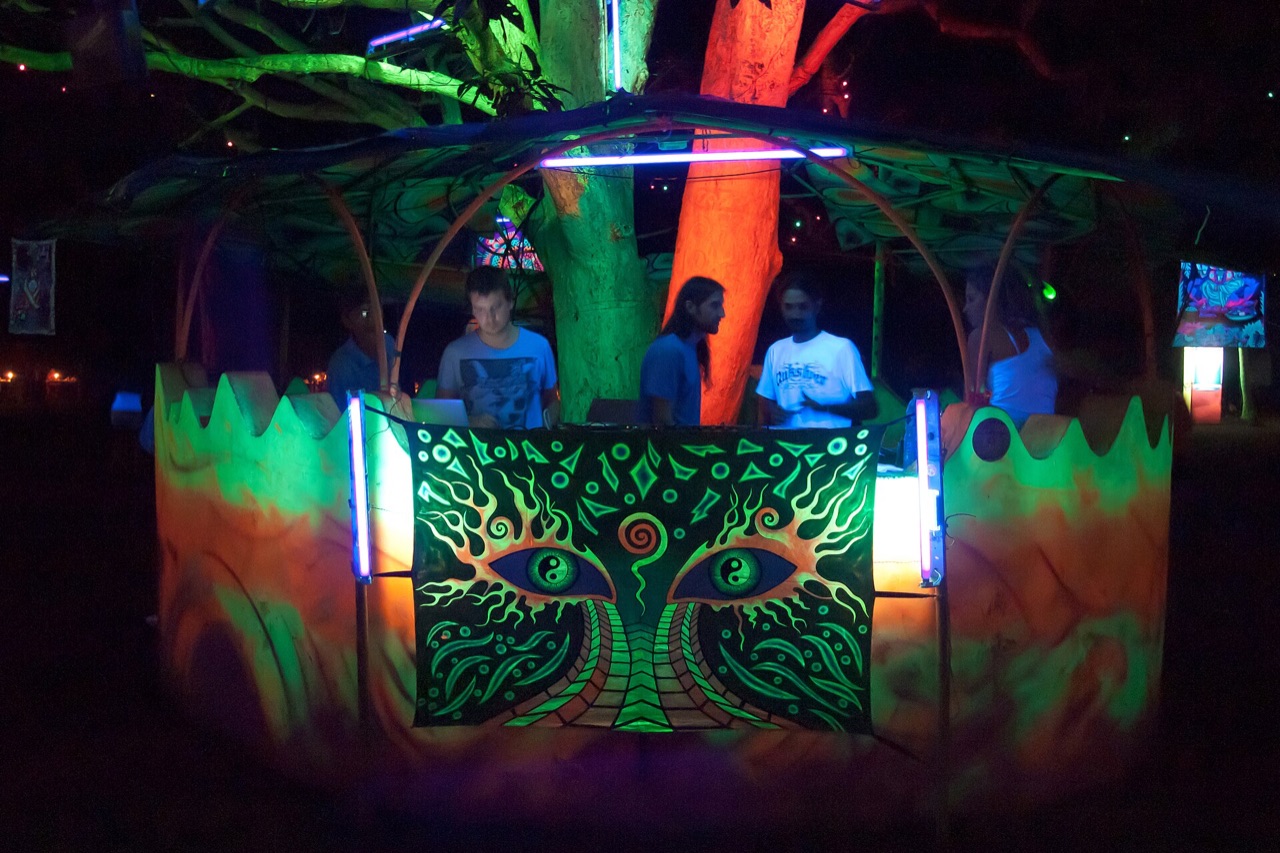 Documented scene · Goa partyLate 1980s → mid-1990s
Rave and Goa’s electronic nights
Britain; Goa, India · DJs, travelers, local scenes
Contemporary cultural historyOpen field note + source ↗A sonic and social context; no claim that Goa invented ecstatic Dance.Evidence: scholarship traces UK acid-house/rave growth around 1988 and Goa’s seasonal DJ-led culture through the 1980s into Goa trance in the 1990s.
Relationship: electronic Dance music was one ingredient the later named format drew upon. The scenes had different social norms and histories.
Significance: Rave and Goa scenes broadened the sonic and social possibilities of long, DJ-led communal Dance. Electronic music became one ingredient in the later named format, whose social agreements were different.
Dancecult on Goa ↗ · Oxford on UK rave ↗Image: Vyacheslav Argenberg, Vagator Goa trance party (2010) ↗ · CC BY 4.0 ↗; resized/display crop. This later DJ scene is not an image of the 1980s–90s origins.
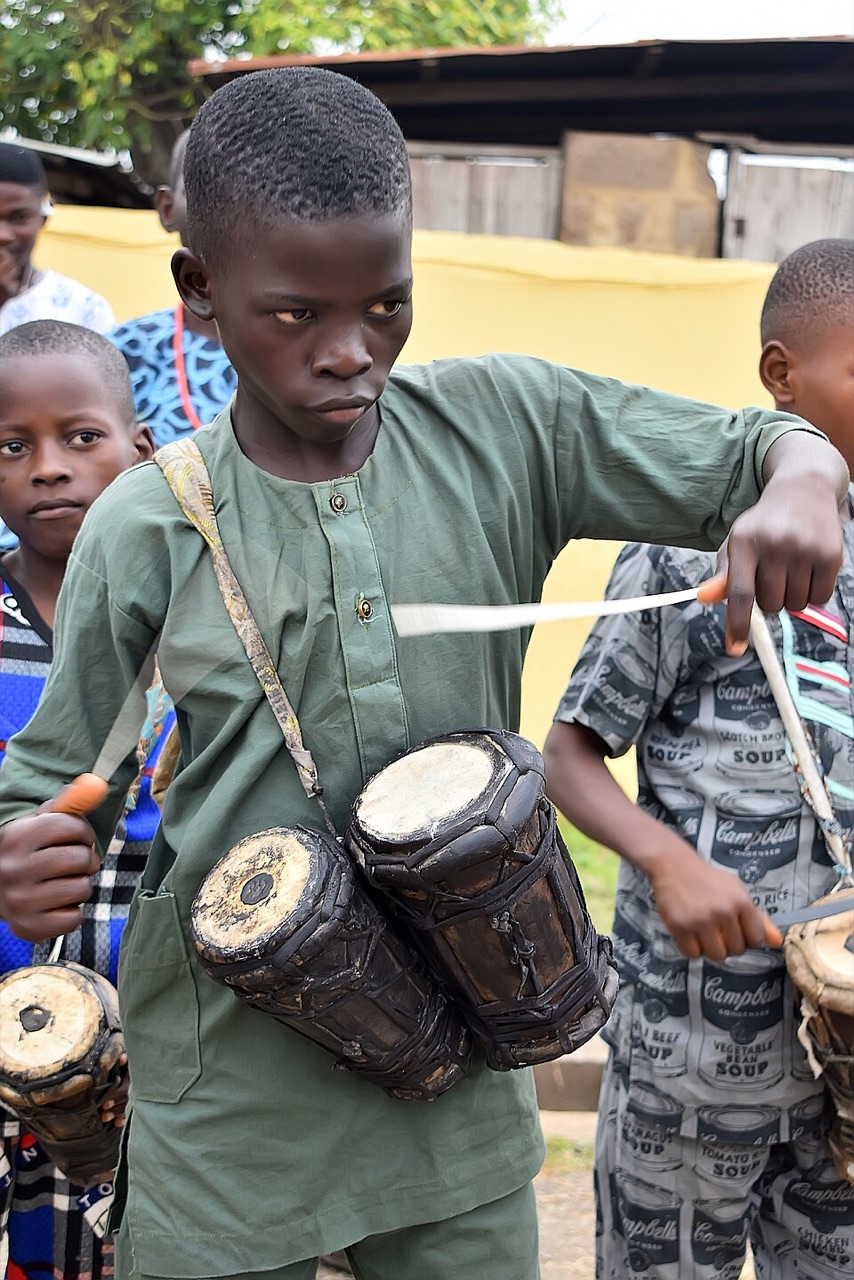 Documented instrument · bàtá drums1996 release · older living practice
Yorùbá bàtá for Ṣàngó
Pobè, Benin · Yorùbá ritual musicians and dancers
Living tradition / recordingOpen field note + source ↗The release date marks documentation, not the origin of Yorùbá ritual.Evidence: a Smithsonian Folkways release from 1996 identifies a bàtá ensemble and a Ṣàngó rhythm specific to Pobè. The source does not establish the recording date.
Relationship: this is a precise West African example, linked by real diasporic histories to some orixá traditions in the Americas. It is not a generic “tribal beat” or a proven direct source of the modern Ecstatic Dance format.
Significance: The named bàtá and Ṣàngó example makes a particular relationship among drums, Dance, and worship audible. Real diasporic histories connect West African and American orixá traditions; no direct source claim for modern Ecstatic Dance follows.
Smithsonian Folkways recording ↗Image: Comradeayobami, bàtá drummers (2019) ↗ · CC BY-SA 4.0 ↗; resized/display crop. This is not the 1996 recording or a documented Ṣàngó rite.
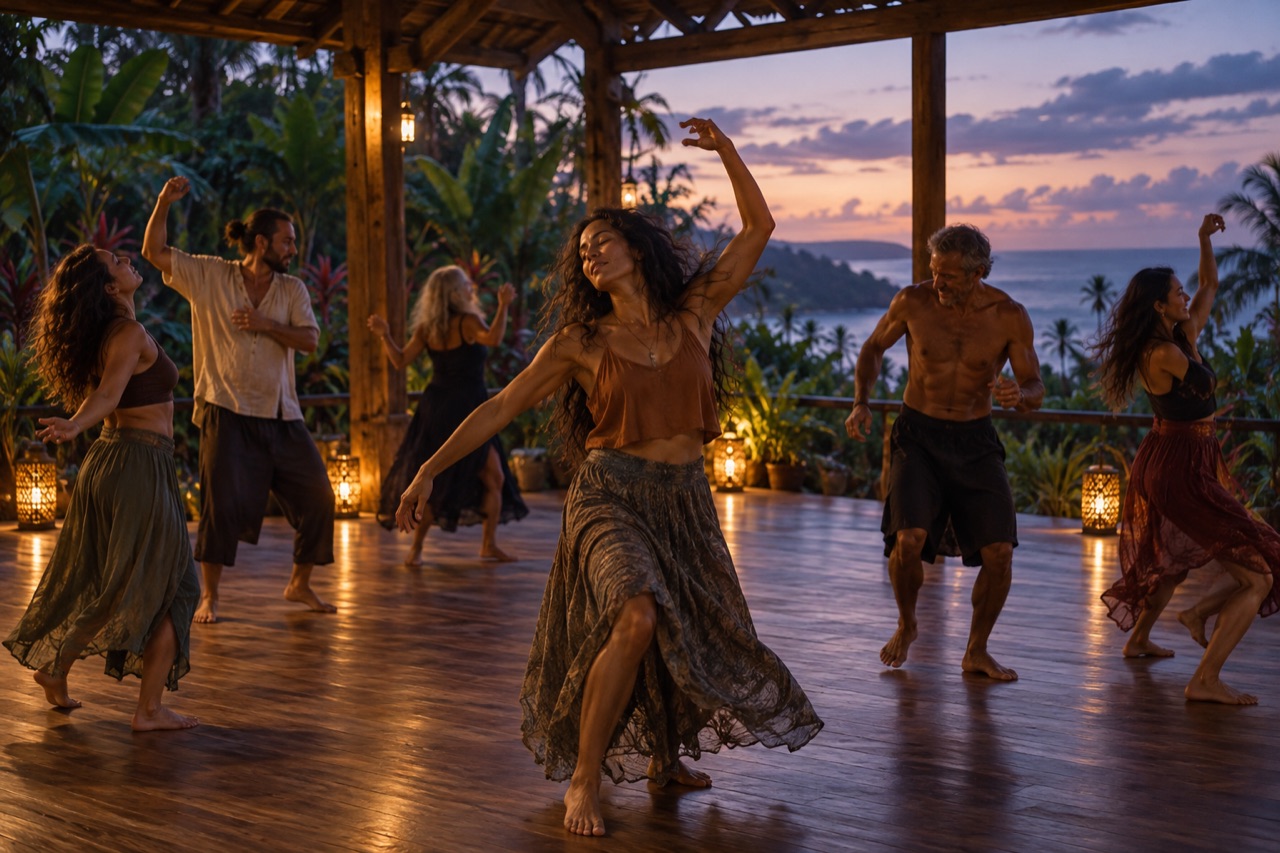 AI interpretation · island gatheringAround 2000–01 · organizer accounts differ
Kalani, Hawaiʻi Island
Puna, Hawaiʻi · Bodhi Tara, Max Fathom, Elizabeth Betwixt
Participant historyOpen field note + source ↗Hawaiʻi matters to this format’s history; hula remains a separate tradition.Evidence: The movement’s history places the shift around 2000, while Kalani dates Max Fathom’s arrival to 2001. Both accounts describe Bodhi Tara’s existing mixtape Dance, Max’s later organizing, and Elizabeth Betwixt’s contribution.
Limit: this is a participant account of one modern format’s emergence. It is not evidence that all ecstatic Dance began in Hawaiʻi or that hula generated this format.
Significance: Organizer accounts at Kalani describe how a DJ-led gathering, musical wave, and shared floor agreements became a portable modern format. Its later spread is traceable; the origin of human ecstatic Dance is not.
Ecstatic Dance organizer history ↗ · Kalani’s account ↗Inside this one formatEcstatic Dance floor agreements
Common agreements for the named, DJ-led format—not rules for every form of communal Dance:
- Substance-freeCome without alcohol or intoxicants.
- No talkingLet the Dance portion unfold without conversation.
- No shoesBarefoot where possible; footwear for medical or access needs.
- No camerasKeep phones, photos, and video off the floor.
Consent, room to rest, and respect for others shape the space too. Local organizers adapt their agreements. Sources: Kalani guidelines ↗ · Ecstatic Dance basic tenets ↗
Image: AI-generated interpretive scene of an open-air Hawaiʻi Island Dance floor; it is not a Kalani archival photograph; it is not an archival photograph and depicts no verified event or person.
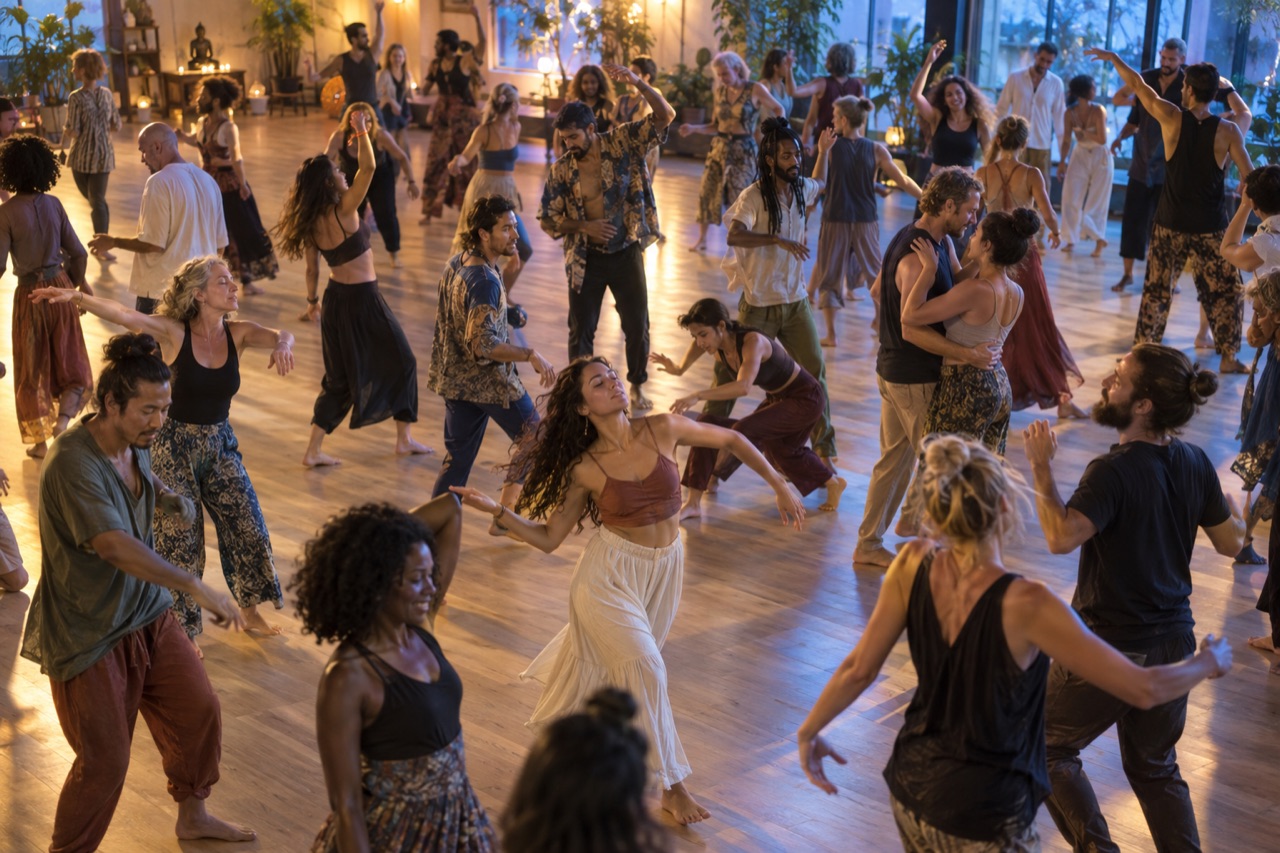 AI interpretation · contemporary floor2000s–2026 · organizer history & directory snapshot
Global proliferation of Ecstatic Dance
Locally run gatherings · multiple regions
Participant history / directory recordsOpen field note + sources ↗1,009 listings are not 1,009 active weekly Dances or a participant count.Spread: the organizers’ history describes independently run Dances taking the name in cities including Grass Valley, Berlin, Amsterdam, New York, Barcelona, Arambol, and Ubud. This traces one modern format, not descent from older ceremonies.
Directory snapshot: on 29 September 2026, the initial public directory page contained 1,009 unique listing records (counted by card ID). It also contained paused or ended listings and repeated titles.
2026 field sample: Public organizer schedules and event pages show recurring Dance slots in North America, Latin America, Europe, and Australia; examples and source links appear below. Social posts and directory cards can go stale, so each Dance needs a date check before attending.
Worldwide weekly Dances and participants: no reliable total was found. A listing does not verify that a gathering is active, how often it meets, or how many people attend. Kalani reports 200–350 dancers at its own Sunday gathering; that single site cannot be scaled to the world.
Significance: Independent scenes show that the name and format have traveled internationally and adapted locally. The listings invite further verification, while the absence of a global weekly census keeps any participant total hypothetical.
Organizer history ↗ · Public directory ↗ · Kalani attendance claim ↗Image: AI-generated interpretive scene of a present-day communal Dance floor; it is not evidence for the directory’s global counts; it is not an archival photograph and depicts no verified event or person.
How many floors are moving tonight?
This source-linked sample of 26 organizers or scenes documents Ecstatic Dance and closely related free-movement sessions, including some with two weekly slots. It shows the reach of this contemporary scene; it cannot count the world's communal or ceremonial Dances or establish a global growth rate.
What might weekly attendance look like?
Move the controls to imagine a range of weekly gatherings, from 1,009 to 100,000. 50 dancers per gathering is Alex’s field estimate, not a measured global average.
The starting 1,009 counts public directory records, not verified active weekly Dances. This result is a what-if scenario, not a global attendance estimate.
50,450illustrative participant-visits per week
Repeat visitors count each time they attend.
Explore 26 sourced scenes
Organizer sites and calendars support the stronger entries. A directory entry or local roundup is a lead, not proof of this week’s event. Public Instagram and Facebook links helped locate scenes, but followers and RSVPs are not attendance. No current weekly branded listing was confirmed for New Jersey in this pass; that does not imply an absent scene.
- Boulder, Colorado · US
Boulder Ecstatic Dance
Sun · organizerOrganizer says 100–150 dancers
Inspect listing ↗ - Wheat Ridge, Colorado · US
Rhythm Sanctuary
Thu · 2026 scheduleWeekly, dated September artists
Inspect listing ↗ - Colorado Springs · US
Root & Release
Sun · dated eventFree-movement format; Oct 2026 event
Inspect listing ↗ - San Francisco, California · US
MOVEMENT SF
Sun · organizer listingPublic weekly schedule
Inspect listing ↗ - Venice, California · US
Ecstatic Dance LA
Sun · organizerWeekly Sunday claim
Inspect listing ↗ - Seattle, Washington · US
Seattle Ecstatica
Tue + Thu · organizerTwo separately advertised weekly slots
Inspect listing ↗ - Kīlauea, Kauaʻi · US
Ecstatic Dance Kīlauea
Sun · organizer-linked directoryWeekly listing warns of occasional venue cancellations; check its Instagram before attending.
Inspect listing ↗ - Puna, Hawaiʻi · US
Kalani Ecstatic Dance
Sun · organizerOrganizer reports 200–350 dancers
Inspect listing ↗ - Todos Santos · Mexico
Ecstatic Dance Temple
Sun · venuePublic venue schedule
Inspect listing ↗ - Amsterdam · Netherlands
Ecstatic Dance Amsterdam
Tue + Sun · organizerTwo weekly slots and dated October tickets
Inspect listing ↗ - Hackney, London · UK
Ecstatic Dance UK
Wed + Sun · event calendarTwo streams of dated September events
Inspect listing ↗ - Freiburg · Germany
Black Forest / Freiburg
Weekly · organizerWeekly event; DJ Subtill self-reports average attendance above 100.
Weekly schedule ↗ · Attendance claim ↗ - Melbourne · Australia
Ecstatic Dance Melbourne
Fri · organizer listingWeekly listing; verify fresh date
Inspect listing ↗ - Uvita · Costa Rica
Awake Uvita
Sun · organizer listingOlder dated instance; current week unconfirmed
Inspect listing ↗ - Puerto Viejo · Costa Rica
Puerto Viejo / Kona Shala
Sat · local roundupsFour September roundups; local source
Inspect listing ↗ - New York, New York · US
Ecstatic Dance NYC
Tue · directoryDirectory explicitly says check socials
Inspect listing ↗ - Munich · Germany
Ecstatic Dance Munich
Sat · directoryWeekly directory claim; fresh date unconfirmed
Inspect listing ↗ - Byron Bay · Australia
Ecstatic Dance Byron Bay
Wed · directoryWeekly directory claim; fresh date unconfirmed
Inspect listing ↗ - Paris · France
L.O.V. Ecstatic Dance Paris
Weekend · dated listingLate September and early October dates
Inspect listing ↗ - Austin, Texas · US
Austin Ecstatic Dance Center
Sun · 2026 dated calendarTwo Sunday sessions are listed on multiple September and October dates.
Inspect listing ↗ - New Paltz, New York · US
Hudson Valley Silent Disco
19 Sep 2026 · one eventDated Ecstatic Dance event; no weekly recurrence established.
Inspect listing ↗ - San José / Uvita · Costa Rica
BEYOND DANCE
Sun + Sat · directoryOrganizer-linked listing describes multiple Costa Rica locations; check current dates.
Inspect listing ↗ - Ubud / Uluwatu · Bali
RISE Ecstatic Dance
Tue + Thu · dated 2026Venue lists weekly sessions with September–October dates.
Inspect listing ↗ - Ubud · Bali
Samyama Ecstatic Dance
Wed · dated 2026Venue lists weekly Wednesdays, including 30 September.
Inspect listing ↗ - Ubud · Bali
Resonanz
Thu · 3 Sep 2026Ticket page calls it weekly and caps this event at 50; capacity is not turnout.
Inspect listing ↗ - Barcelona · Spain
Espai Philae
Monthly · dated 2026Venue lists October, November, and December dates; monthly, not weekly.
Inspect listing ↗
Method: named organizer/venue pages, public Dance directory cards, event calendars, and accessible social links reviewed 29 Sep 2026. Multiple slots from one organizer appear once in this scene count. Attendance claims are the organizers’ own estimates. The snapshot cannot establish worldwide totals or a rate of growth.
A constellation is not a family tree. The ancient question keeps finding new rooms.